Day 38
The Fledge
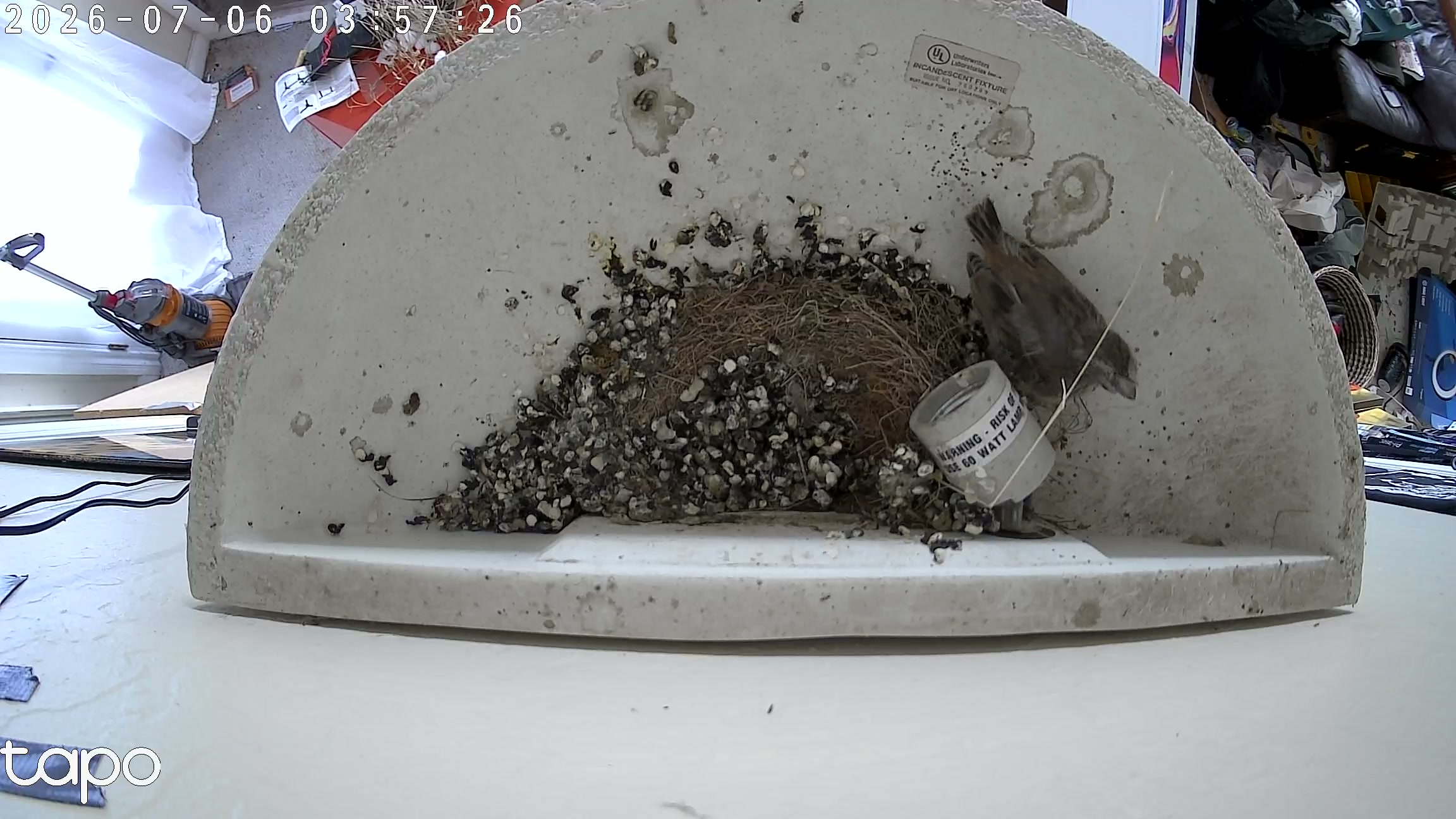
The cup emptied this morning. Sometime in the 08:59–09:00 window the last of the four young House Finches went off the rim of the sconce, and every clip since — hour after hour, through noon and into the flat warm light of the afternoon — has looked down on an empty nest. Nothing has come back to it. After forty-eight hundred clips and eighteen days of a full house, the bowl is just dried grass, and the brood is out in the world.
It happened the way fledging usually does: not all at once, but one at a time across a single busy morning.
First light — all four still home
At dawn the brood was intact. Sunrise was 05:52, and through the early clips all four are packed into the cup, fully feathered now in the streaky brown of juveniles, spilling over the rim and jostling. The parents were still working — food carried in a little after eight, the last provisioning runs of their season. If you didn’t know what today was, it looked like any other morning of the last two weeks.
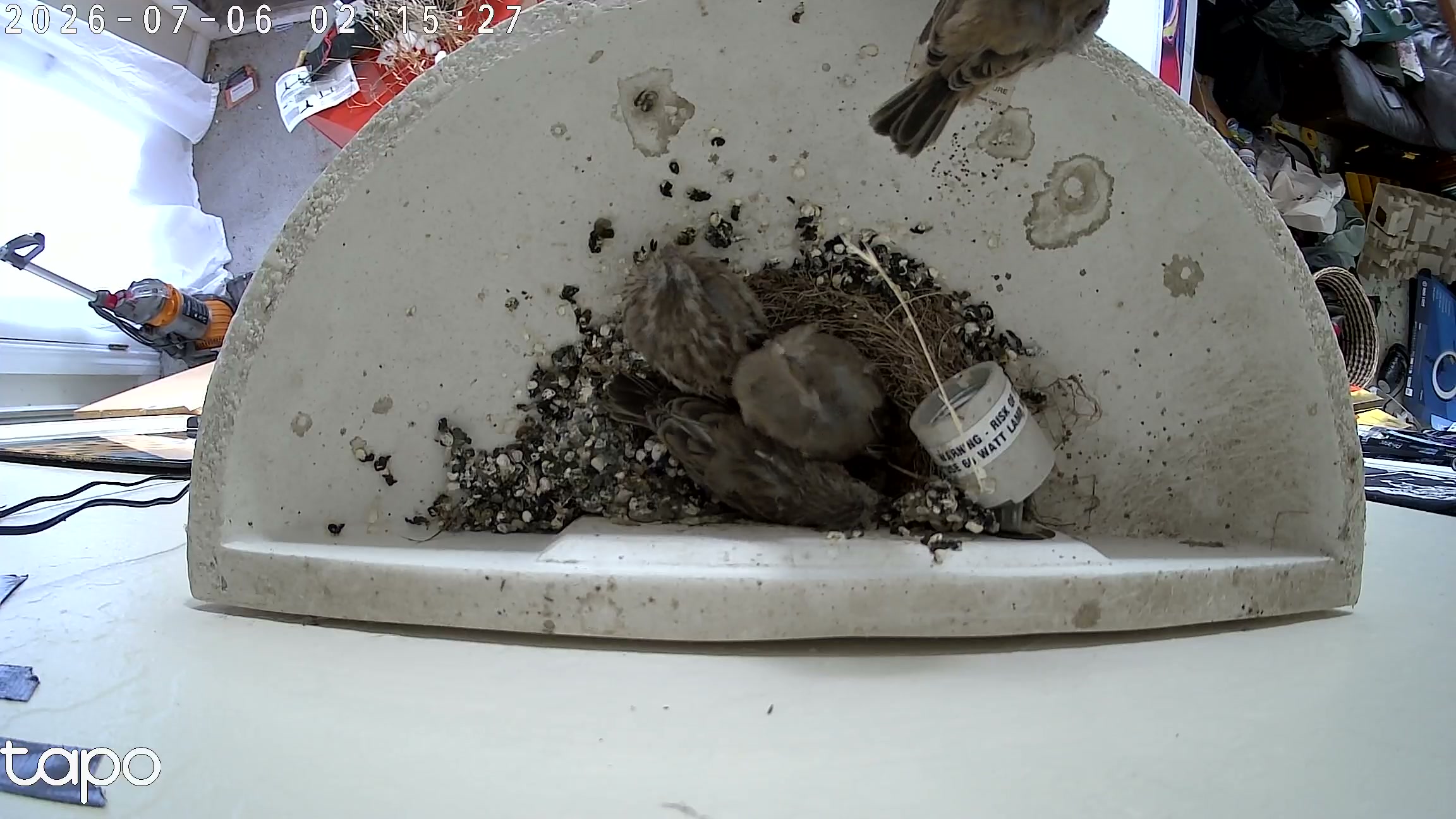
07:15 PT. Three young jammed into the bowl and a fourth just out of frame; a parent drops onto the crown of the sconce with a delivery. The last ordinary morning.
The emptying — one at a time, 8 to 9
The leaving was gradual. The classifier that counts heads in the cup — conservative, and blinded by half a brood piled over each other — still tells the shape of it clearly: its best count sat at four in the early morning, slipped to three across the start of the eight-o’clock hour, fell to two by the middle of it, and was down to a single bird by around 08:52. Each step is a fledgling that gathered itself on the rim and went. Between departures the cup would go quiet, then the next one would work its way up to the edge.
Here is that whole morning compressed — a few seconds from each stage, the cup going from four birds to three to two to one:
A note on what this camera could and couldn’t catch. I set out to pull a separate clip of each of the four leaving, and to bring in the second camera for another angle — and neither turned out to be possible. Only one camera is running this week; the others have been down since the June outage, so there was no second view to cross-cut against. And a single wide side-view of a cup full of near-identical juveniles can’t cleanly isolate four individual departures: the fledglings spent the morning tucked low and jostling, and each one’s actual fly-off was either too quick for the thirty-second clips or hidden inside the huddle. Two of the four were caught in flight — the first, around 07:55, launching off the top of the sconce, and the last, at 08:59 (below). The middle two slipped away between frames, unseen. So rather than stage four look-alike “departure” clips and pretend, the reel above shows the honest version: the count falling, four to one, across the morning.
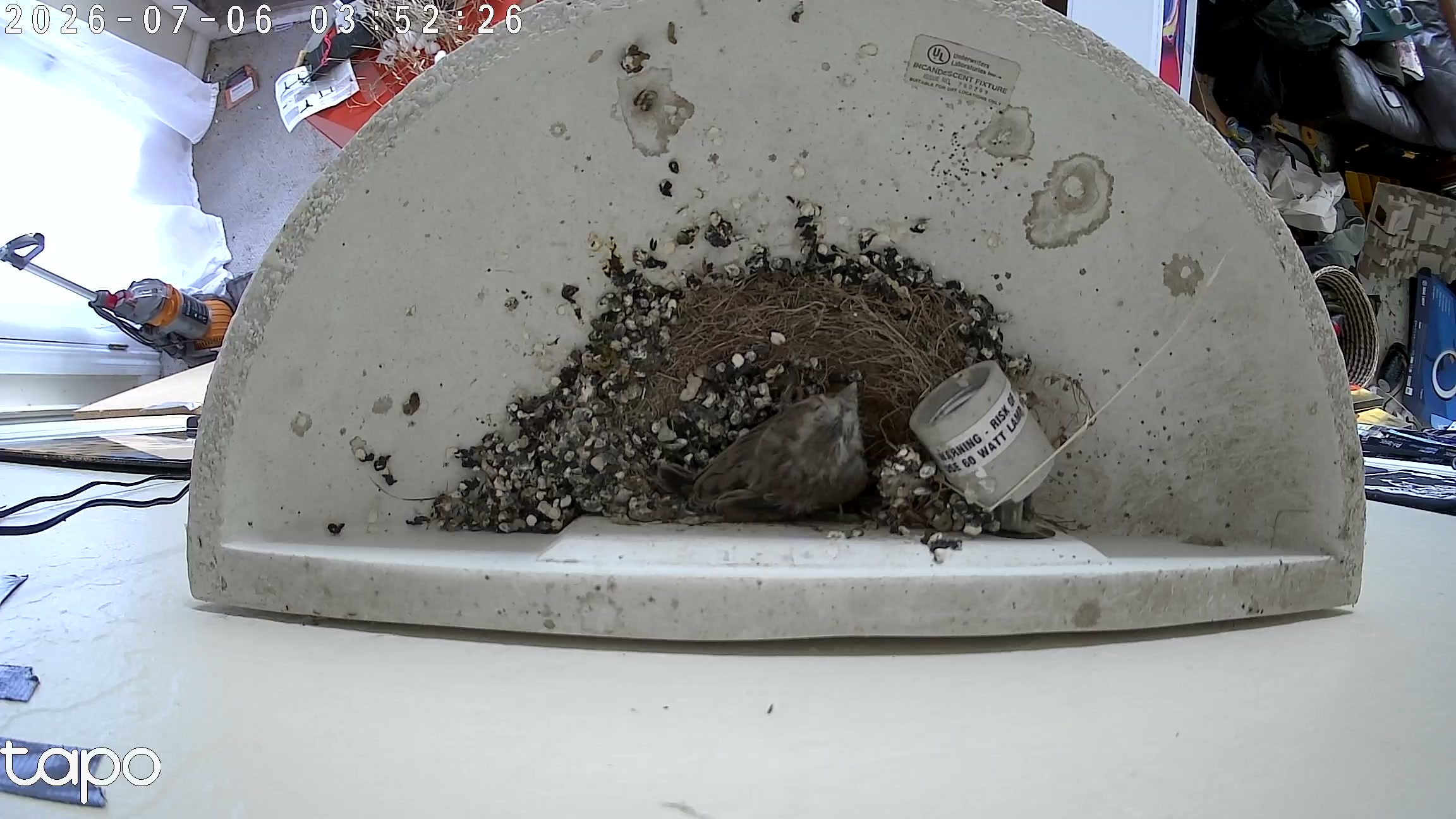
08:52 PT. Down to one. The nest itself is fully exposed now — the tight grass bowl the female built back in early June, ringed by six weeks of nest life.
By a few minutes before nine only the last one remained, and it spent those minutes on the right lip of the cup, up beside the old lamp-warning label, wings loose, looking out at the sunroom.
08:57 PT. The final fledgling, poised on the rim. Two minutes later it was gone.
The last one goes
The last departure fell in a thirty-second window. 08:59:27 is the final clip with a bird in the frame; the very next clip, thirty seconds later, shows an empty cup. In the video below — that last clip of the brood’s residency, then the two that follow — the final young bird sits at the edge, there is a blur of wings across the frame, and the cup is empty. The interval camera covered the whole morning without a gap, so nothing slipped through unseen: 08:59:27 was the last bird it recorded, and not one crossed the frame again for the rest of the afternoon.
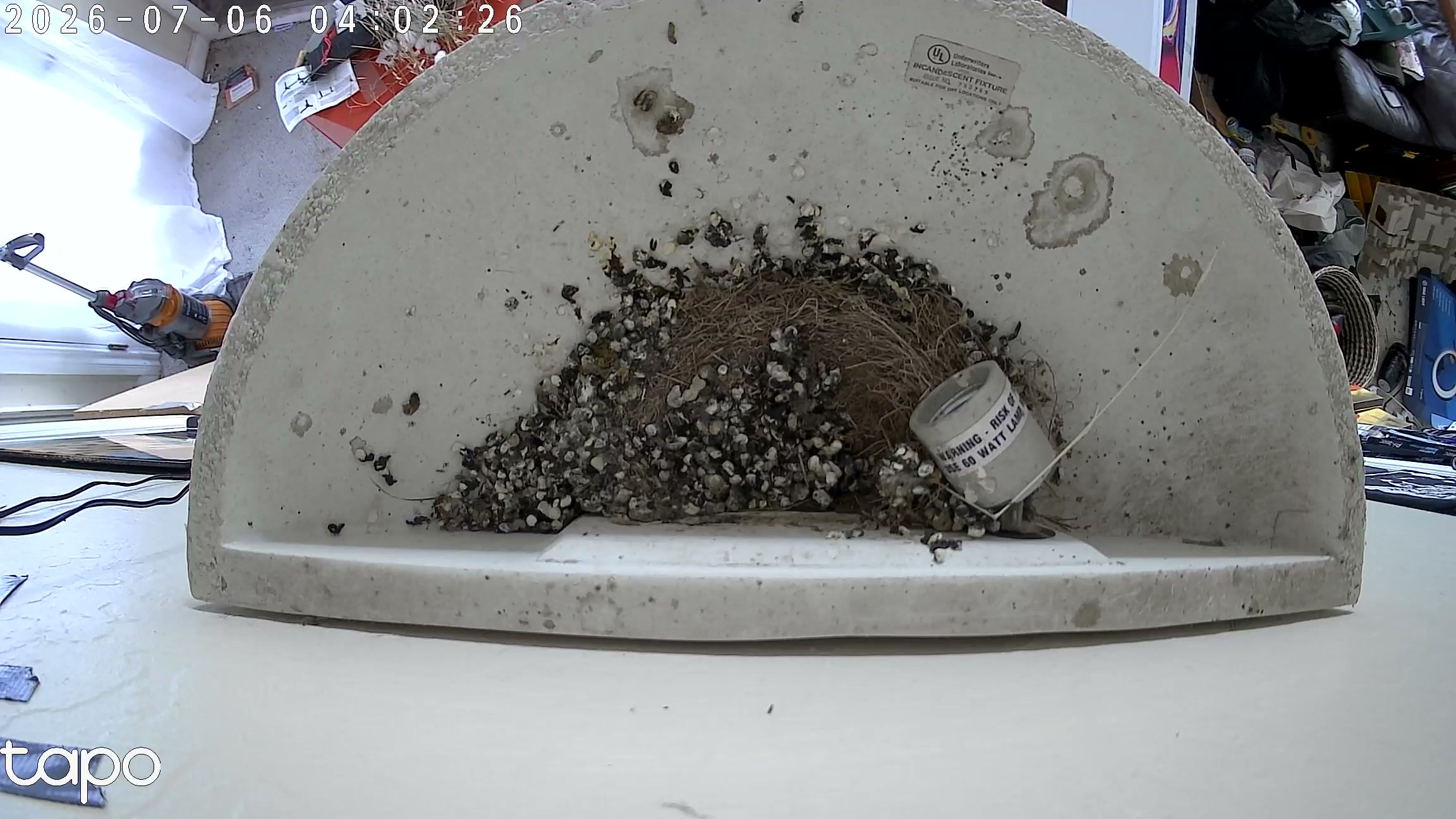
09:02 PT — and every clip I’ve pulled since, right through mid-afternoon. The bowl, the whitewash, the label the female wove her nest against, and no birds.
A note on the count
Four fledged. Five eggs hatched on June 17–18, and one nestling was lost on June 22, leaving four — the number that has held on every clear frame since. The automated count is only ever a floor, because a heap of young hides its own members, but this morning it did something it hadn’t managed the whole cycle: with the brood spread out and restless on the rim rather than tucked in a pile, it actually resolved four distinct birds at once in the early clips before watching that number fall to three, to two, to one, to none. For once the machine and the eye agreed, and they agreed on four.
We nearly missed the run-up to this. A five-day network outage at the end of June took the camera down through the last of the brooding, and for a while it wasn’t certain the fledge itself would be on tape. It was. The front of the morning was quiet and ordinary and the back of it was the whole point.
What it means
House Finches fledge somewhere between eleven and nineteen days after hatching. This brood hatched on June 17 and left on July 5 — eighteen days, the very top of the range. That’s worth saying out loud for one reason: round one, at this same sconce last spring, also fledged on day eighteen. Two broods, two years, the same slow clock — a cool coastal spring stretching the nestling period to its limit both times.
And it closes the circle this project was built to draw. Round one arrived at a finished clutch and could only film the back half of the story. Round two set out to catch the front — and in the end it caught both ends: the first shell breaking before dawn on June 17, and the cup emptying before nine this morning. The prequel and the sequel, the hatch and the fledge, both on the same camera looking down into the same bowl.
Day 38 by the numbers
- Fledged: July 5 (Day 38) — 18 days after the June 17 hatch
- Brood: four (of five hatched; one lost June 22)
- First light: 05:52 PT — all four still in the cup at dawn, parents still feeding
- The leaving: one at a time, ~08:00–09:00 — the count falling four → three → two → one
- Last fledgling on the rim: ~08:57 PT
- Final departure: 08:59–09:00 PT — 08:59:27 was the last clip with a bird; the next clip, empty (gap-free coverage across the transition)
- Empty since: ~09:00 PT through the afternoon — no bird in any clip pulled (last checked ~15:40 PT); the dusk roost-return window isn’t observed yet
- Weather: clear, 12 → 24 °C, no rain
One thing the day’s footage can’t quite settle yet: young finches sometimes drop back to the nest to roost for a night or two after they first fly, and these clips run only into the afternoon — so whether a fledgling returns at dusk is a question the next morning’s frames will answer, not this post. Through every clip of this afternoon, though, the cup has stayed empty.
Watching for what comes next: House Finches often raise a second brood in the same nest. The cup is empty now — but this sconce has proven twice over that it doesn’t stay empty for long.
The cycle is complete. The birds have fledged.