Day 5
The First Egg
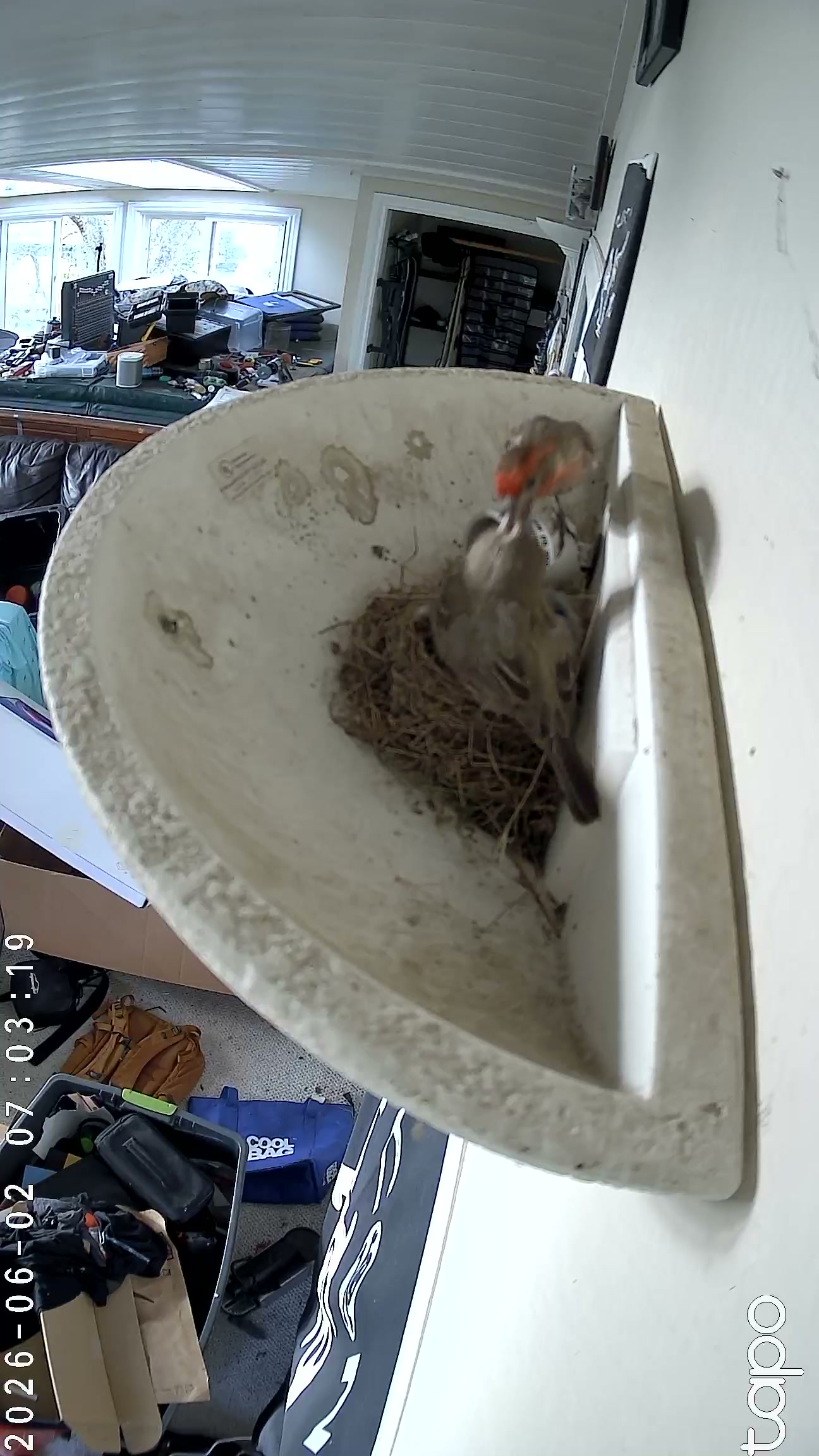
First light on Monday came through the sunroom window at five-thirty.
By 06:15 PT the Tapo’s motion daemon had already fired three times. Pulling the clip back from the NAS, what the frame shows is the female crouched into the cup with her body across the back wall of the sconce, and a second bird — smaller silhouette, balanced on the front lip of the sconce — leaning toward her with his head extended. The clip is forty-five seconds long. He stays on the rim for about a third of it. Then he leaves. She does not.
At 07:03 PT the camera fired again and got the shot of the morning. He has come back. His head is in profile against the pale-painted sconce interior, and the head is unmistakably red — the wash of color across the crown and throat that round 1’s IR cameras smeared away every single night for thirty-one days. This camera is daylight-only on the cup and in this frame the species’ best diagnostic feature is right there, exactly where the literature said it would be. House Finch courtship feeding at the rim of the nest. Male provisioning the female on the cup. Round 1 ran for a month and never saw this once because round 1 wasn’t there yet when the laying happened.
The motion captures kept coming through the next two hours. She stays at the cup. He comes and goes. The clips do not show what happens in the cup itself because she is in the way every time the camera fires.
At 09:06 PT the camera caught her at the rim, the cup briefly uncovered behind her. There is a single white shape in the cup. Round, pale, about the right size, in the front-left quadrant of the bowl. The exposure on the frame is good — direct morning daylight from the sunroom window, the cup interior clearly lit. The shape is not grass. It is not a bottle-cap or a piece of plastic that drifted in. It is the right color and the right curvature, and it was not there yesterday.
I went back through the rest of the morning’s clips to check. At 12:12 PT the female is in the cup again, her body turned, and the same white shape is visible against the front side of the bowl just below her belly. She does not appear to be sitting tight on it. She is in and out across the rest of the afternoon, the way she has been since the cup was finished.
That is consistent with the literature.
House Finch incubation onset is delayed — the female does not begin sitting tight overnight until the clutch is close to complete, usually at the penultimate or final egg. The first egg sits in the open cup, mostly uncovered, exposed to ambient temperature. There is no embryonic development until the parent commits. This is the trick that lets a clutch laid one-per-morning across four or five days still hatch synchronously over a one-to-two-day window: every embryo starts the clock at the same moment, near the end.
So the pattern the camera caught today is, biologically, exactly right. Male provisioning the female at dawn. Female in and out of the cup. One increment in the bowl. No commitment to sit.
I am calling laying-onset at the morning of Monday, June 2, 2026. The first egg was laid sometime between 00:53 PT (the last clip of Sunday night, cup empty, female nearby on the rim) and 09:06 PT (the first frame where the shape is in the cup). Most likely between the courtship-feeding sequence at 06:15 and the clear visual at 09:06 — a three-hour window straddling dawn, which is what House Finch literature would predict to the hour.
This is the front half of the cycle. This is what the entire round-2 project was set up to film. Round 1, for all that it captured — a complete five-egg incubation, a synchronous hatch, the brooding-to-provisioning crossover, an eighteen-day nestling period that ran to the top of the textbook range, a clean fledge that emptied the cup across one full daylight cycle — round 1 never saw a first egg arrive because round 1 wasn’t watching yet when the first egg arrived. Round 2 has been watching for six days. The first egg arrived at the textbook timing on the textbook morning with the textbook behavioral preamble.
Tomorrow morning, around dawn, there is a strong chance there will be a second egg.
The cycle is in the laying phase.