Day 4
Day 4 — The cup is finished
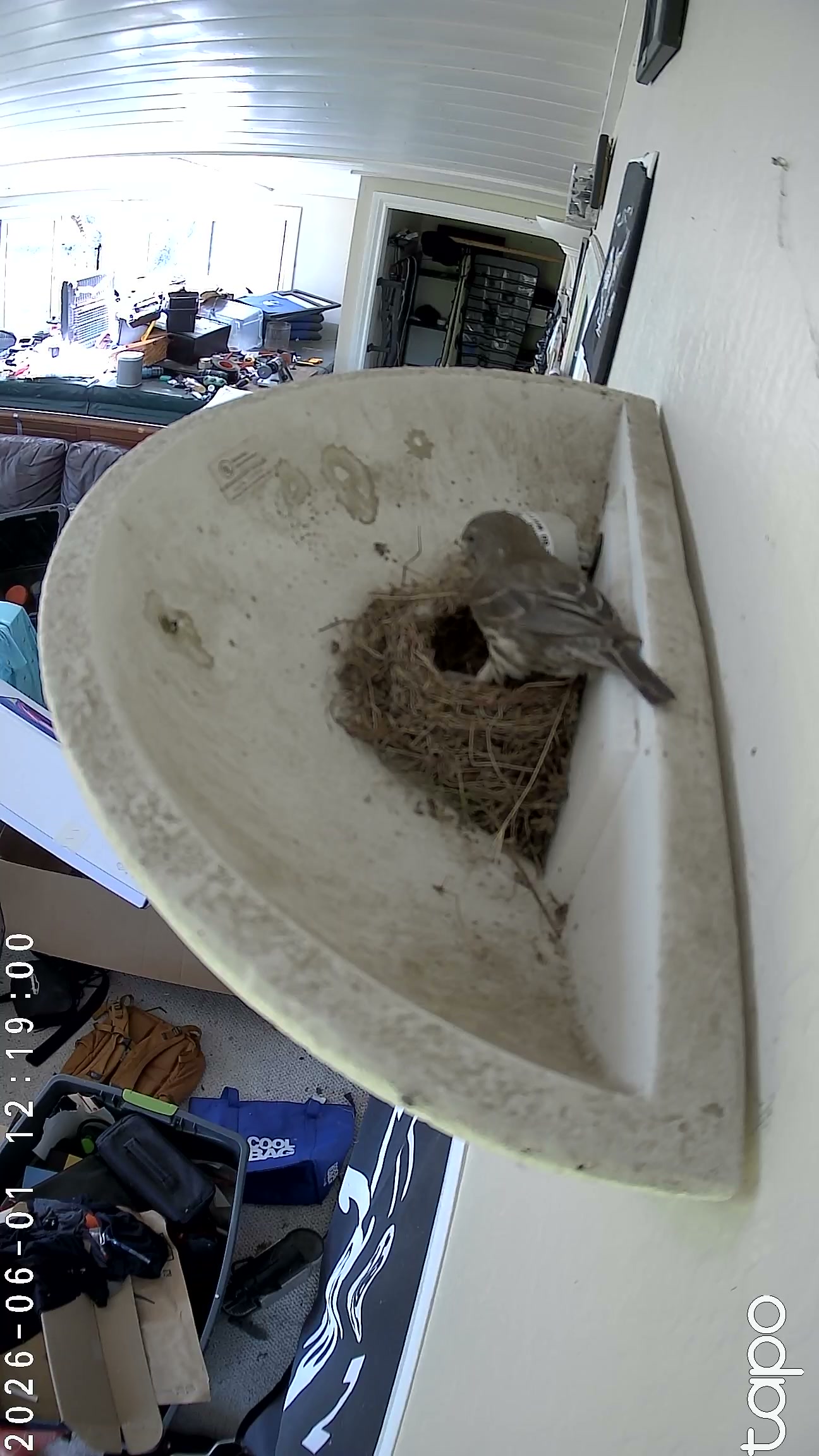
Sometime late on Day 3 the building work stopped looking like building.
By the time the Tapo woke on Sunday morning the rim was a finished rim. Material wasn’t being added — material was being pressed, turned, smoothed. The female would arrive at the cup, settle in for a few seconds, leave again. No grass in her beak coming or going. The motion captures through the morning catch her at the edge of the sconce, then in the cup, then out again, then gone for a stretch. The cup is, as far as the camera can see, finished.
At 12:19 PT I pulled a frame from a clip where she had just left and the cup was uncovered to the camera. There was nothing in it. Just the brown grass interior, the dried fibers shaped into the deep tight bowl that House Finches always build, the pale lining at the bottom. No egg.
I checked again at three more points through the afternoon. Same answer. Nothing in the cup yet.
This is the part of the cycle round 1 never recorded — the waiting. A cup that is finished, an adult pair that is committed, a window that biology says is one to several days wide, with one egg expected per morning once it opens. House Finch clutches are typically four or five, sometimes six, sometimes only two. The female does not commit to sitting tight until the clutch is near-complete; that is the trick that gives the species synchronous hatching from staggered laying. The textbook answer to “when does it start” is tomorrow morning, or the morning after, or maybe the one after that. The data answer comes from the camera.
The camera caught 133 motion clips through the day. There was no daily post on the blog because the auto-classifier hit a 403 from Google’s API at the Gemini step — a billing issue on the back end that paused the pipeline. The capture daemons kept running. The clips are on disk. The cup is finished.
I will know about the first egg when the camera sees it.