Field dispatch
Before the Eggs
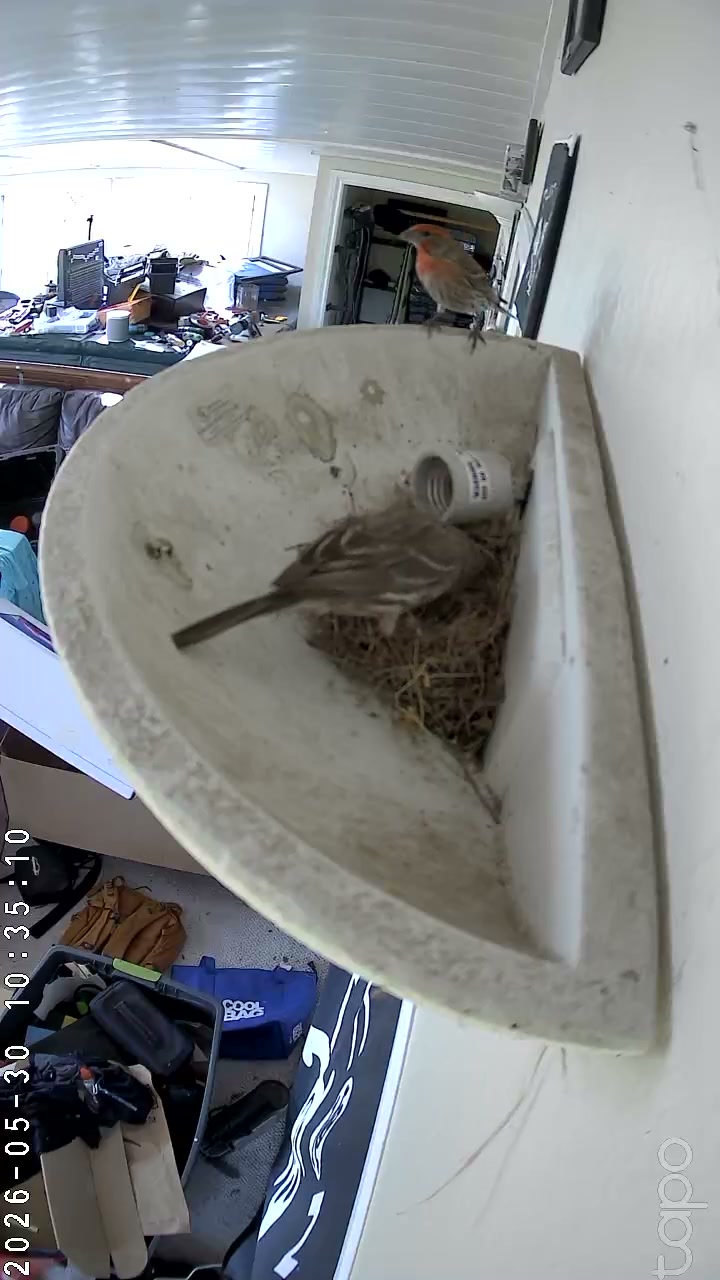
The week after fledge was quiet.
Round one — the thirty-one-day journal that closed on May 25 and now lives at birbs-archive.cje.io — ended on Day 31 with the bookshelf cup sitting empty across a full daylight cycle. Five chicks gone. Both parents gone. The sunroom went back to being a sunroom. I half-expected the silence to last the rest of the season.
It lasted a few days.
What I started hearing, in the second half of that week, was chirping again — coming from the same room but the wrong direction. The bookshelf was still empty when I checked. The sound was on the other wall. House Finches are frequently multi-brooded, sometimes two or three times in a season, and they often reuse the same general site. They had not reused the bookshelf. They had moved across the room, to a half-dome wall sconce above the workbench, and started building inside it. The shape of the fitting is almost exactly the shape of a nest cup, and they had clearly decided that was the point.
This time, the cameras are up before the eggs are.
By the time I first looked closely at the bookshelf cup on April 25 last cycle, the female was already settled on a complete clutch of five. The story I followed was the back half of the cycle. The front half — the cup taking shape, eggs arriving one per morning, the female’s delayed settle onto the clutch — was already over. The whole reason this chapter exists is to film what last time structurally could not. The first egg has not been laid. The female is building.
House Finch nest-building runs five to seven days, intermittent and unhurried. The female does almost all of the work, returning to the cup with a beakful of grass or fine fiber, pressing and turning it into the rim, leaving again. The male tracks her, often perches nearby, and provisions her by what the literature dryly calls courtship feeding — bill to bill at the rim, food passed over. It looks tender. It also functions: he is shortening her foraging trips so she can stay close to the cup, and conditioning her physiology toward laying. The trips are slow at first and gather into a rhythm. Then one morning, an egg.
The new pipeline is built to be ready for that morning.
Two cameras went up in the sunroom last night — Tapo tight on the open face of the sconce, Reolink wider for room context — and four launchd jobs began landing clips on the NAS at 19:01 PT. The classifier has been pre-loaded with the corrected prompt from round one (the single most expensive bug last cycle was a missing sentence about female-only incubation and the IR-tucked-shape problem; it is baked in from clip one this time). Per-clip prose, daily aggregates, and the public journal will run when the biology arms them. None of that fires before the first egg. Capture is cheap. Building is expensive. Birds are unpredictable. If this pair abandons before laying, the only thing that cost us is some launchd time. If they don’t, every later stage is already specified and waiting for its trigger.
Two things to watch for in the days ahead. The first is material-carrying — short visits with grass in the beak, building activity at the rim of the sconce. That phase should run through the rest of this week. The second, the moment everything pivots on, is an egg-count increment in the morning. Day zero. Per-egg arrival logged in true laying order. Per-egg infrared ROIs calibrated from the moment each shell first shows up in the cup, not retrofitted weeks later from a frozen reference. That is the experiment round one structurally could not run.
Until then: the cup is taking shape inside the sconce, the female is in and out, the male is on the rim.
The journal is open.