Hatch Day, Days Early
The hatch was supposed to be next week. Going by a 13–14 day House Finch incubation and a clutch finished around April 25–26, the window I was watching for was May 11 through May 14. Instead, yesterday morning, I checked the cameras and found chicks. Four to seven days early. The hatch itself happened overnight, under the female, and no camera saw it. By the time she lifted off the cup for her first morning shift just after seven, two of the five eggs were already chicks. The work was done in the dark.
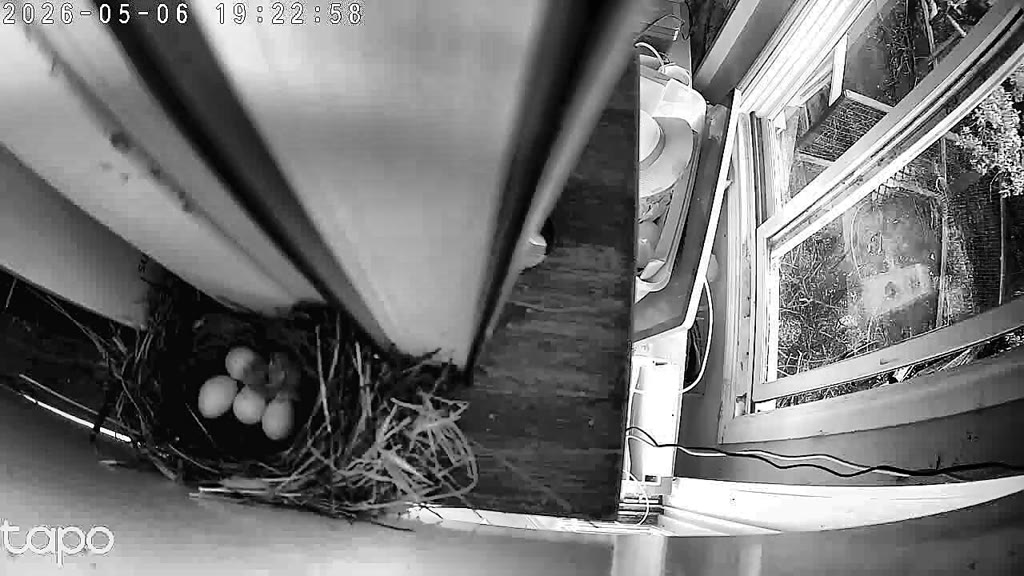
The night before — Tuesday May 6, 19:22 PT, last good light — the cup held five intact eggs. Five smooth pale-bright ovals piled in the dried grass, infrared-rendered but unmistakable, no darker shapes among them. Twelve hours later, two of them were chicks.
07:01–07:06. First visible morning shift. At 07:00:46 a brief lift exposes two pale ovals — eggs. At 07:01:32, three pale ovals — still eggs only. Then at 07:05:54 she lifts again and the camera catches a smaller, darker rounded shape under her breast, alongside the eggs. Forty-five seconds later, at 07:06:39, she’s fully off the cup for the first time of the day, and the enhanced IR shows it: two bright pale ovals beside two darker rounded shapes. The IR signature reads cleanly once you’ve calibrated to it. Eggshell is smooth and reflective, so it renders bright. Pink chick skin reflects less, so it renders dark. Two eggs, two chicks. First clean view of the new state.
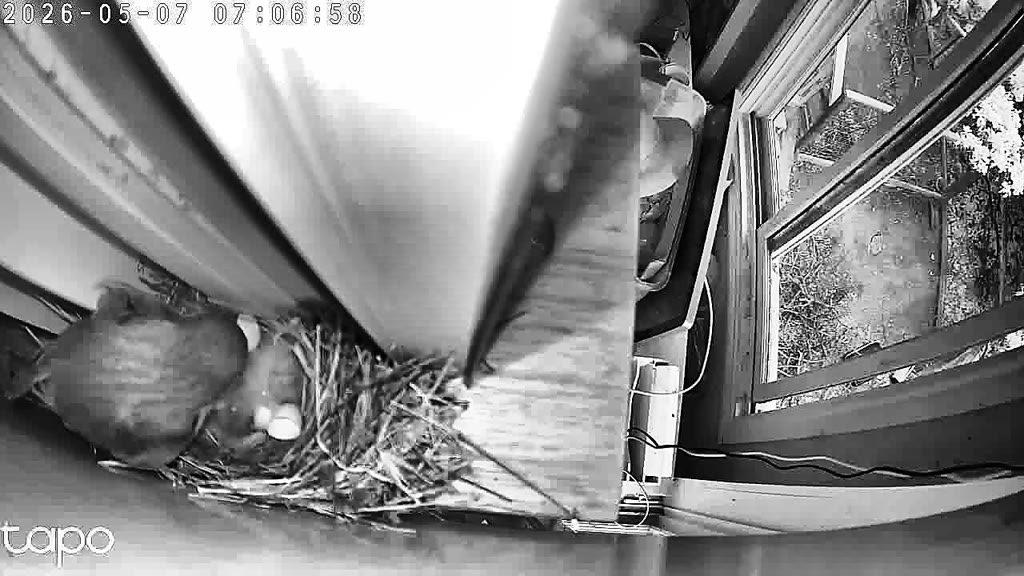
The actual hatch event was earlier than this. House Finch chicks emerge over hours, not minutes, and she sat through the whole window without leaving the cup. By the time the camera could see anything under her, two of the five had already broken out. My best bracket on the first egg cracking is “sometime between dusk on the 6th and dawn on the 7th” — twelve hours of overnight incubation under continuous female cover.
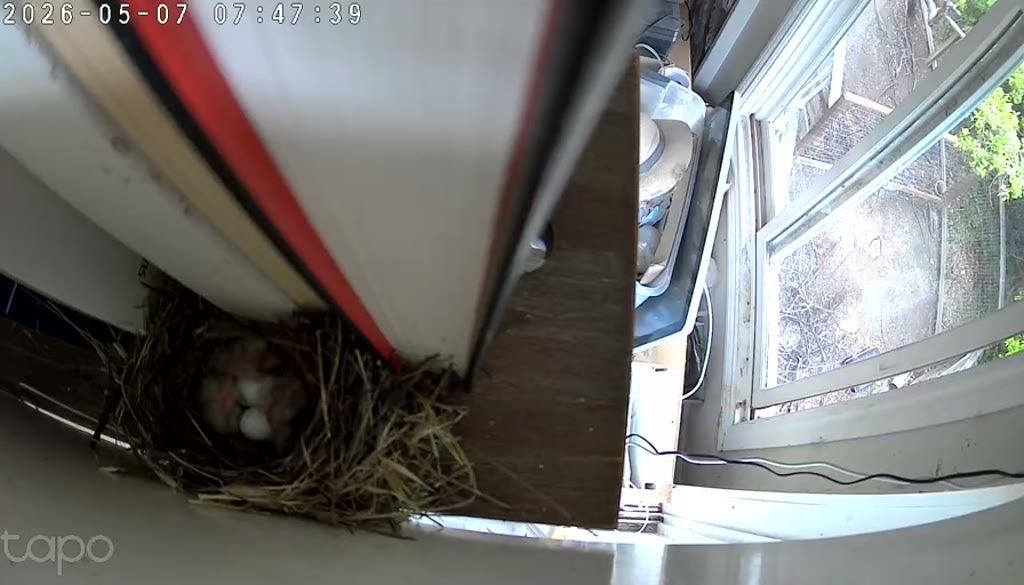
07:47. Color confirmation. The female steps off again, the cameras are now in full daylight, and the Tapo close-up catches the cup unambiguously: two pale-blue speckled eggs and one pinkish, sparsely-downed chick curled between them. The chick I could only infer from the IR rendering at 07:06 is now plainly visible — pink skin, eyes shut, fine sparse down. Visible count drops from “two chicks” at 07:06 to “one chick” here, but that’s almost certainly occlusion. At 07:06 the camera had a wider angle on the cup; at 07:47 the angle is tighter and a chick can easily be tucked behind the egg in the foreground.
A note on the pipeline: the auto-generated morning narrative I read first thing today claimed “five intact eggs at 07:47, settling back in for the morning.” That was wrong. The Phase B summarizer was working from the pre-noon clip set, with a classifier prompt that hardcoded the assumption that the nest was in incubation. The model wrote what it expected. The earlier IR clip at 07:06 was already showing the right answer; the prompt was telling the model not to see it. I’ve since rewritten the prompt to remove the priors — describe what’s visible, don’t import outside knowledge about this specific nest’s state — and re-described the May 7 corpus from scratch.
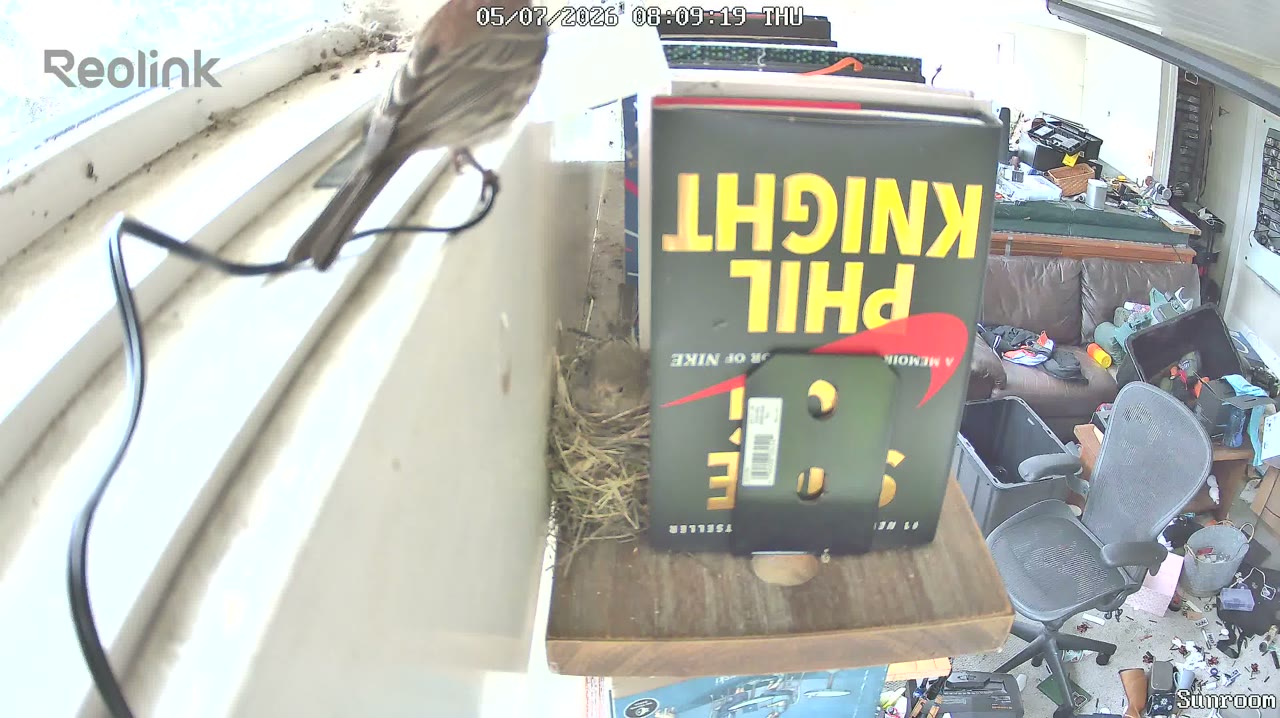
08:09. First proper male visit of the day, caught from the wider Reolink angle: he’s perched on the window screen above the bookshelf, the female is at the nest below. The screen is his usual approach vector — he stages on it for a few seconds before dropping down to the rim.
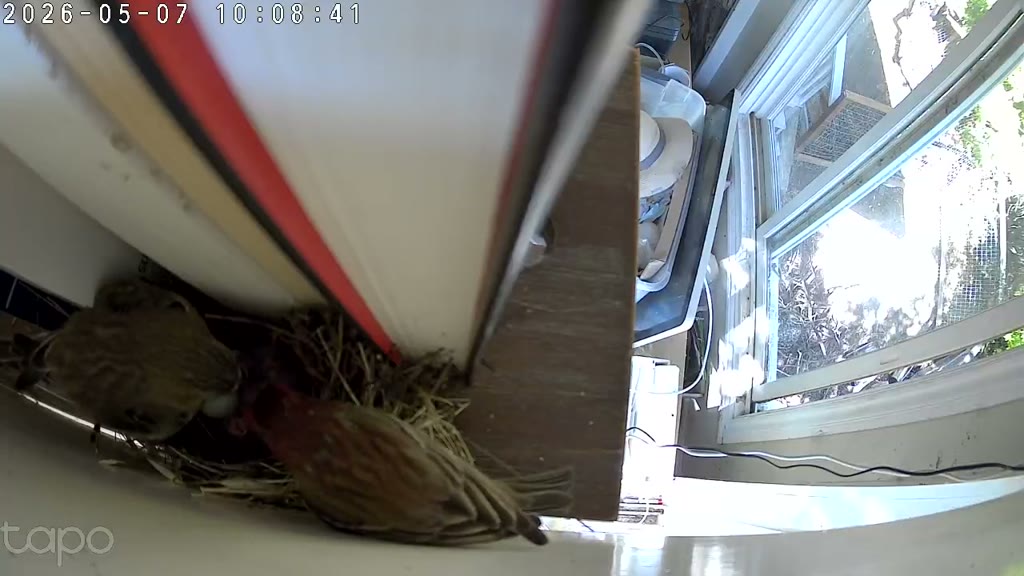
10:08. Both birds at the cup together, and the camera catches it cleanly: female brown and tucked into the cup, male perched right beside her with red plumage clearly visible, and pinkish chick shapes visible in the gap between them. He’s not just here for her anymore — he’s here for them. Whether the food in this exchange is reaching only the female or also the chick(s) under her, the camera can’t tell. Either is plausible; both are likely.
11:28. Motion clip: female lifts slightly. To her right inside the cup, a small pinkish form is visible — almost certainly the same chick from 07:47, now being brooded directly under her. She settles back and it disappears. The state has crossed the line: she’s no longer keeping eggs warm, she’s keeping a body warm that can’t yet warm itself.
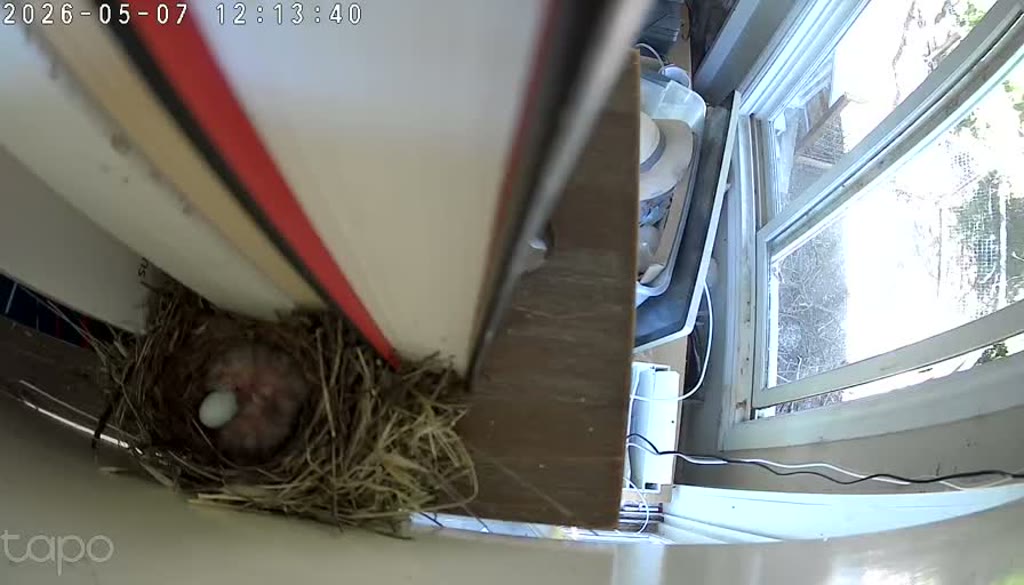
12:13. Cleanest midday view. Female fully off the cup, contents fully exposed. One pale-blue egg. One chick — pink, naked, a few patches of fine down, eyes shut, noticeably larger already than at 07:47. The other three eggs aren’t in frame. Whether they’ve already hatched and the chicks are tucked under nest material, or whether they’re still intact and hidden, this single angle can’t tell me.
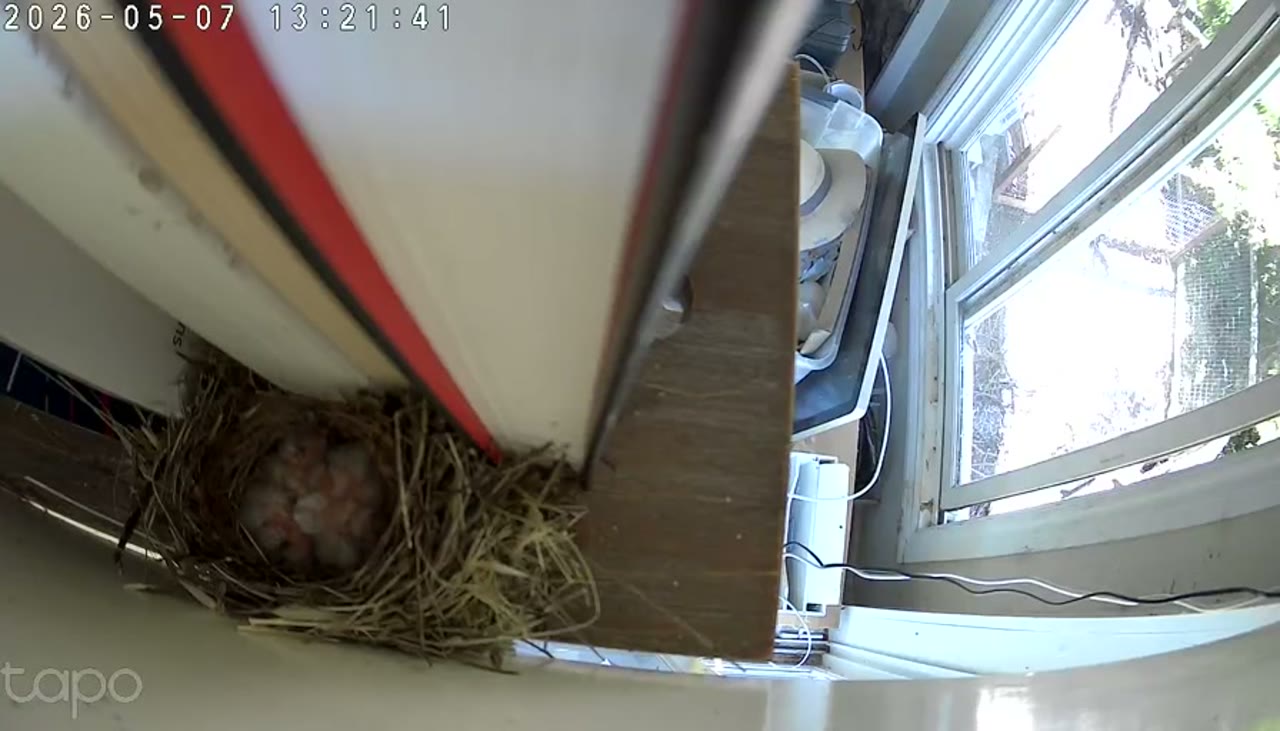
13:21. Different story. Another break, and the cup contains multiple distinct pink shapes piled together. Three chick-sized forms clearly visible; a fourth maybe occluded behind them. No intact egg in this frame.
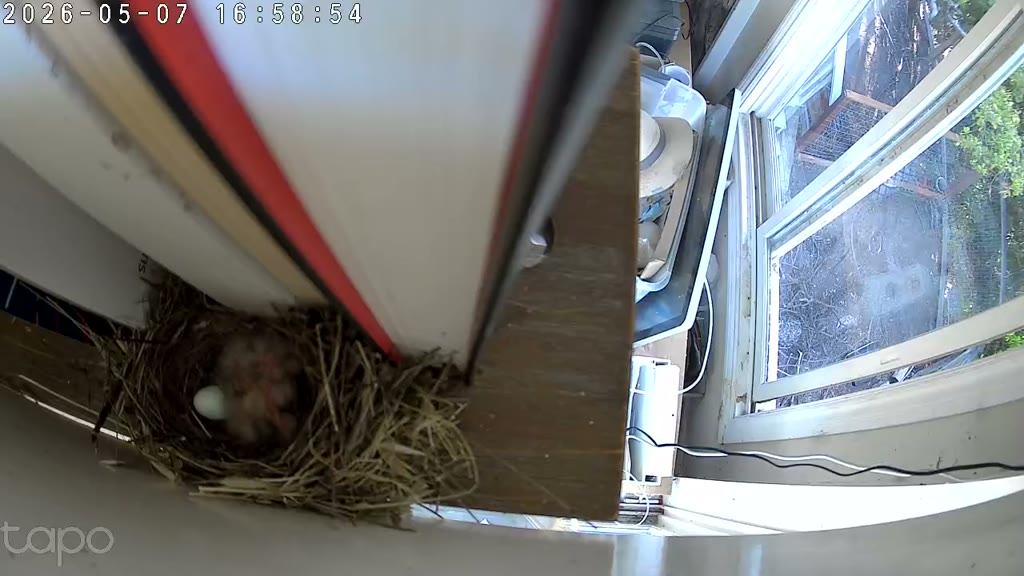
16:58. Cleanest end-of-day count I got. Female steps off, cup fully exposed. One pale-blue egg in the lower-left of the cup. Three pinkish chicks piled together to the right of it. I can make out three distinct chick forms confidently; a fourth is plausible inside the pile but I won’t claim a count I can’t see. The fifth original egg is unaccounted for from this angle. It could be a chick already hatched and tucked under the pile, or an egg still intact and hidden behind the cluster, or something less happy. Three chicks and one egg is the visible state at 17:00. The rest is inference.
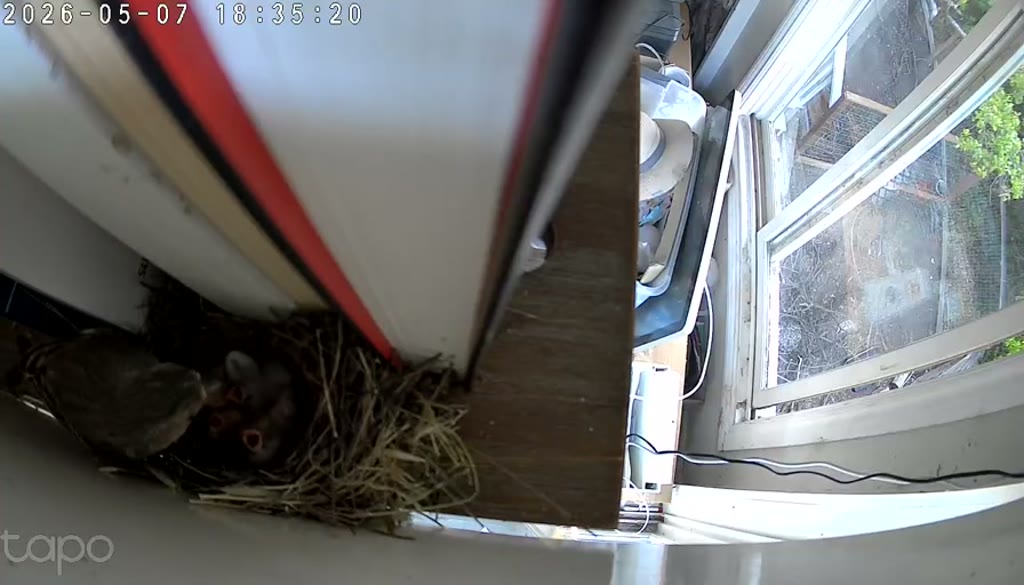
18:35. The most striking shot of the day. Female on the left side of the cup; to her right, two chicks have lifted their heads and opened their mouths in the characteristic begging gape of a newly-hatched passerine. Bright pink, eyes still closed, necks too weak to hold the head up properly, but the gape reflex is fully active. This is the moment the day’s work becomes legible. She’s not warming a clutch anymore. She’s feeding mouths.
20:04. She settles low into the cup as the cameras switch back to IR. Brooding new chicks looks almost identical to incubating intact eggs from this angle and at this time of day — a brown bird hunched in a grass cup, perfectly still. Part of why the early hatch was easy to miss is right here: the overnight footage doesn’t look any different than it has for two weeks.
I don’t know exactly when the first egg cracked. The female sat through the entire overnight window without a single motion event flagging anything unusual. Whatever she did to help the hatch along, she did quietly, in the dark, under her own body. By morning it was done.
What’s still open is the count. Original clutch was five, attested by clean pre-hatch breaks all the way back to April 26. By 16:58 yesterday, the visible state was three chicks and one egg. The fifth might be a chick already in the pile, an egg still intact behind the cluster, or a loss. Tomorrow’s first morning break should answer it.
The forward calendar is short. House Finch nestlings fledge at roughly 12 to 19 days. Eyes open around day 5. Pin feathers break through skin around day 7. Body mass roughly six-fold by the end of week one. Whatever the cameras show tomorrow morning will already be measurably different from what I’m writing about now.
Day’s metrics. 521 clips classified. Sunrise 06:06 PT, sunset 20:05 PT (13 h 59 m of daylight). 12 dad provisioning visits across the day; median 72 minutes between visits, longest gap 89 minutes. Mum and dad together in 40 distinct clips, first co-occurrence at 06:48 PT. On-cup share 96.4% (she barely left). 8 clips with chick gapes captured. Cup contents: 37 eggs-only views, 33 chicks-only views, 29 mixed eggs-and-chicks views. Max chicks counted in a single frame: 3. Max eggs counted in a single frame: 3. No human or disturbance events.