Three Days, the Male Steps in the Cup
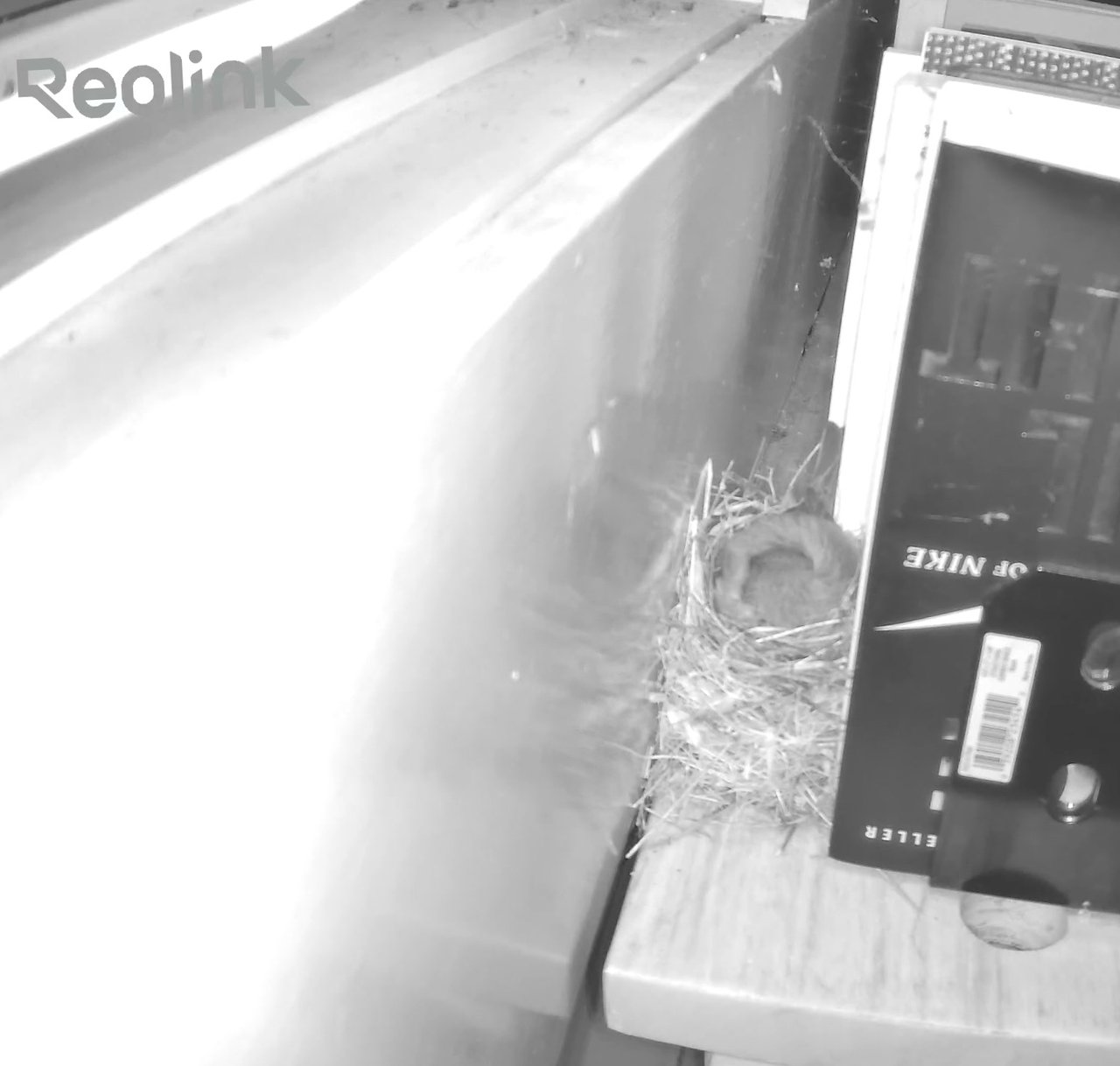
Five eggs, still. The cup hasn’t changed in a week. What’s interesting now isn’t the eggs — it’s how the pair is working around them.
House Finch incubation is the female’s job alone. The male’s role, per the literature, is courtship feeding — he shows up with food, hands it off, leaves. He doesn’t sit on eggs. These three days fit that pattern most of the time, with two specific moments that didn’t.
Friday, May 1. Restless overnight. The IR feed shows her lifting off the cup in stretches that exposed the eggs for an hour at a time. By morning the male’s visits punctuated her shorter recesses: 07:09, 07:59, 11:53, 13:08, 13:09 — five passes, each timed to her movement. Classic feeding cadence. There’s no sign anywhere of him incubating.
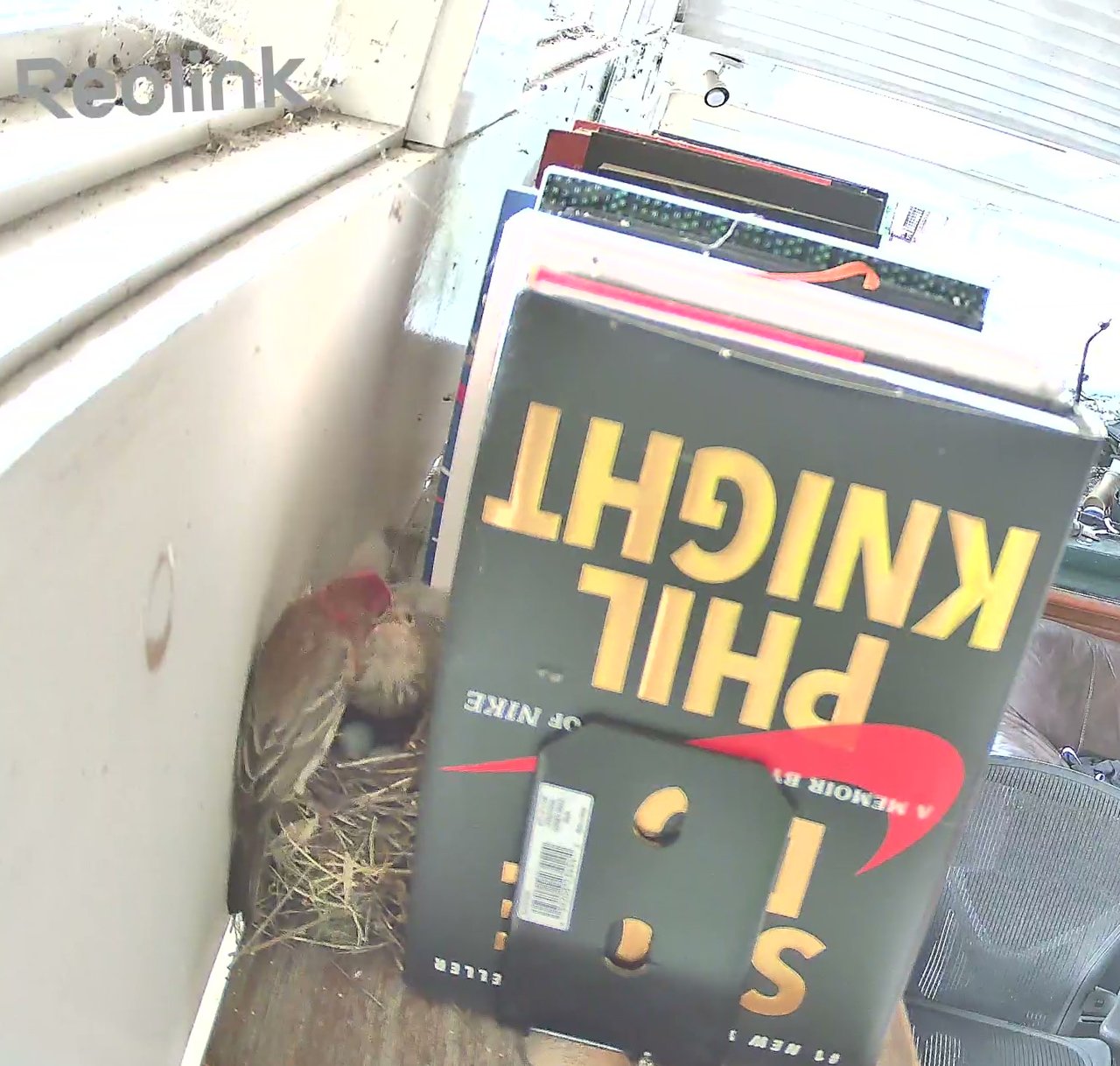
I logged each visit and noted how tightly they clustered around her. He’s not random; he’s reading her. She holds the cup most of the day, with brief breaks to forage or preen. He supports.
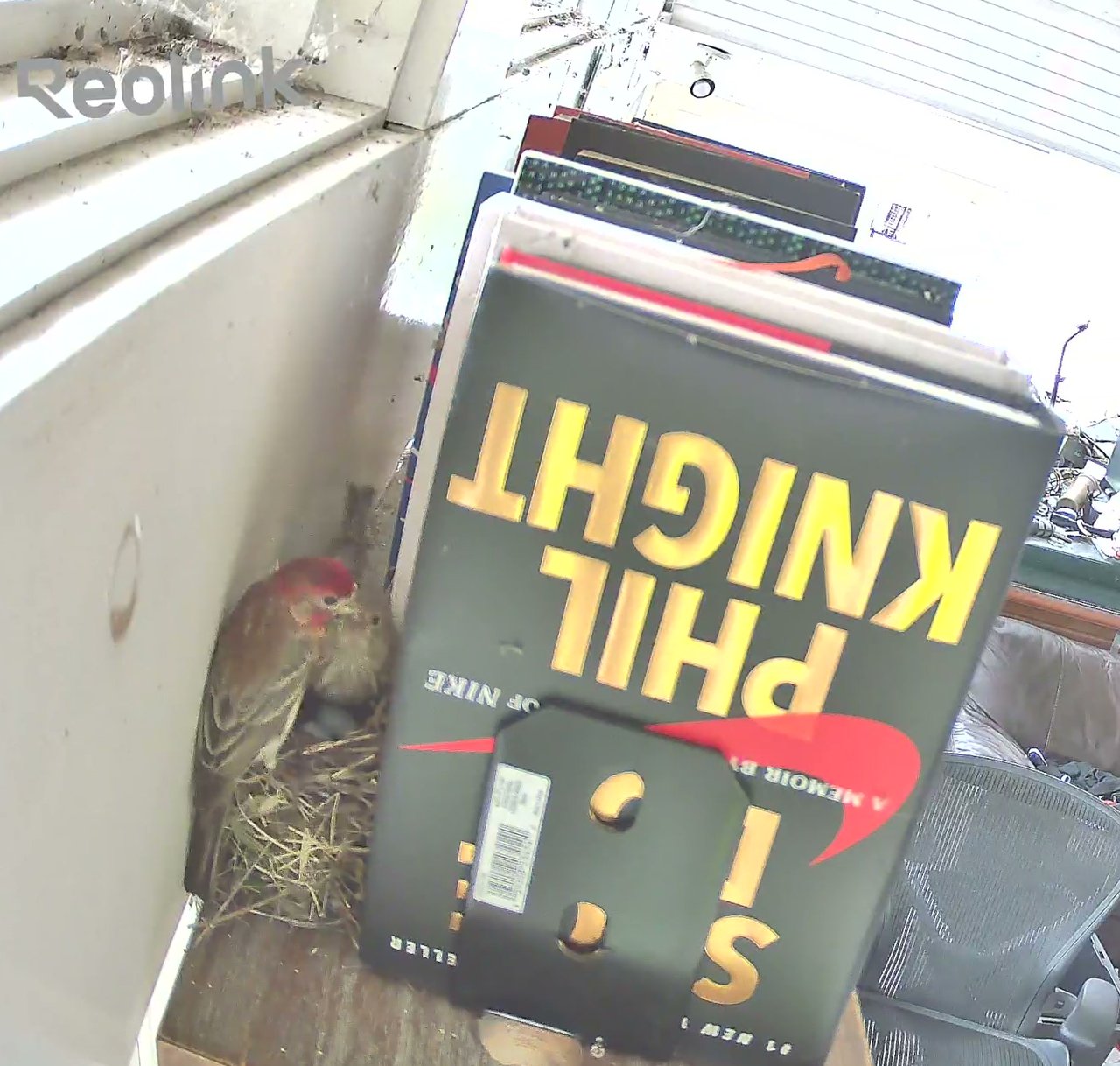
Saturday, May 2. The cleanest example I’ve caught yet of the textbook behavior. At 13:50, male perched on the spine of a stacked book next to the nest, female on the cup below, food handed off rim-to-cup. She stayed on the eggs through the afternoon. Aside from that one visit the male barely registered today.
At 17:22 someone walked through the sunroom — close enough for the Wyze to fire, briefly overexposing and bumping the timestamp into garbage. She was off the cup at that moment but back by 17:41. At 19:12 the cup was empty again, all five eggs lit clean against the grass. By 19:16 she was back. She held through midnight, by which point the cameras had her down to a faint silhouette on the cup edge.
Sunday, May 3. Male traffic surged. Nine visits across the day: 08:37, 09:29, 10:26, 11:42, 15:37, 16:29, 17:26, 18:42, 18:59. Most of them played out as expected — perch at the rim or nearby while she’s on the cup, presumably food exchange, depart. Two were different. At 14:16, with her briefly off, he was visible in the cup for two frames before she returned and took over. At 16:28, she was perched on the shelf below and he was in the cup again. Both events were short. Both fall well outside the literature’s “males don’t enter the cup” framing — but they’re brief, opportunistic, and tied to her absence rather than any sustained brooding.
Between 19:54 and 19:55 someone walked through the sunroom again. The cup was empty in that window. One camera angle suggested an egg might have rolled to the shelf outside the cup — a small bright shape in a place I didn’t expect. A second camera, one minute later, has all five eggs back in the cup. Motion blur or parallax has misled this rig before; I’ll trust the cleaner frame and flag the anomaly. She returned by 20:11 and held through the last IR clip at 22:15.
What the three days say: the female is incubating; the male is supporting; he steps into the cup occasionally during her absences but doesn’t sit. The literature still holds. His brief cup contacts on the 3rd are interesting but they’re transient — checking the eggs, maybe rotating one, definitely not brooding. Whether his unusually high visit count today says something about an attentive pair, an environmental cue I haven’t picked up, or just a Sunday with a lot of food around, I can’t tell yet from three days of footage. The clutch is at five. The female’s incubation persists. The male’s role, however active, stays inside the bounds of the species.