Three Days at the Cup: Male Finch Breaks Protocol
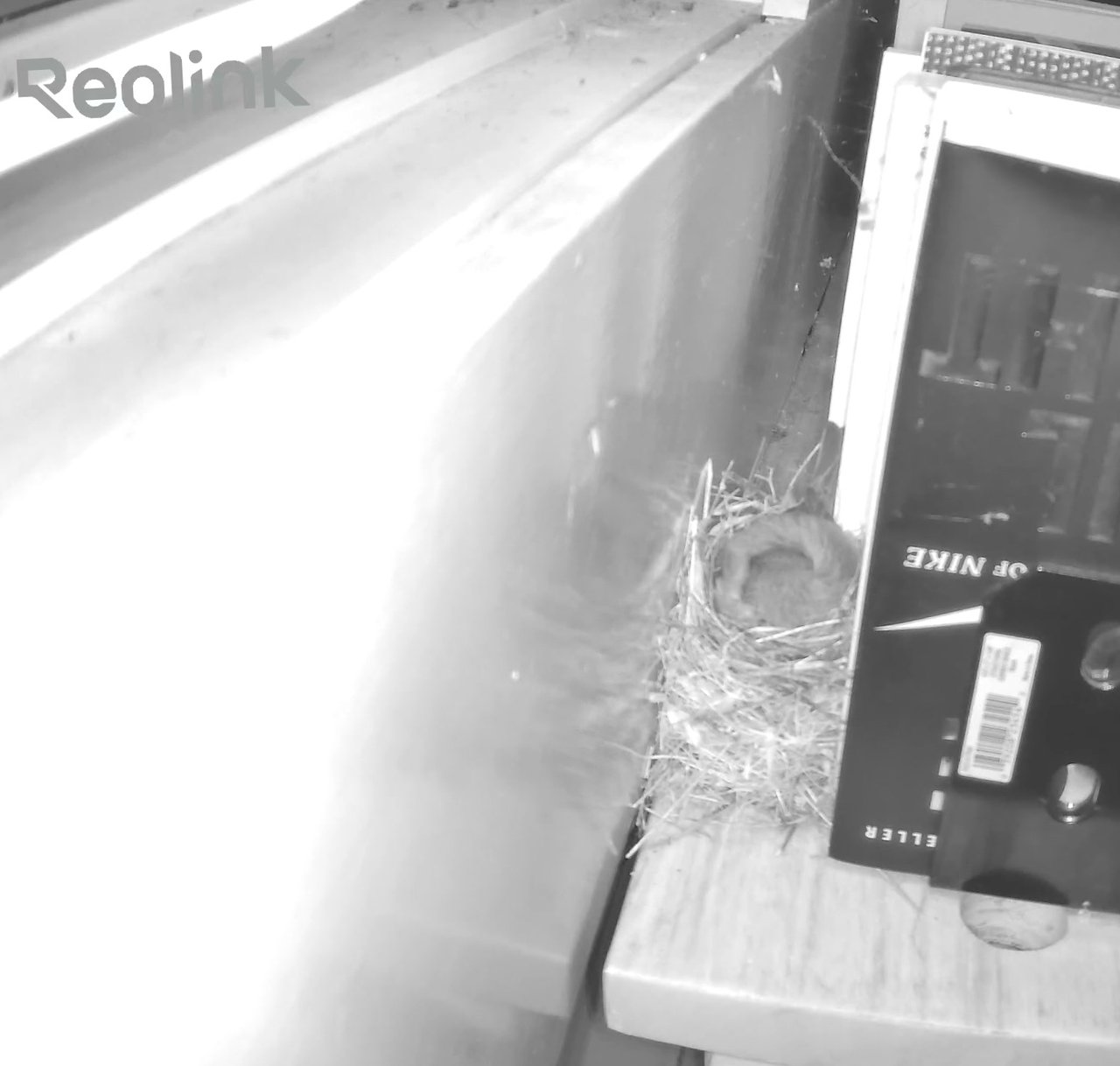
The clutch has held at five throughout this stretch — five pale eggs resting in the woven cup while outside the sunroom windows, May advances. What has changed, and changed noticeably, is not the eggs but the male.
Friday, May 1. The IR frames from overnight confirm the female settled but restless, cycling on and off the cup in increments that feel shorter than they should — gaps of an hour or more showing all five eggs to the camera with no bird above them. By first light something stranger is happening. At 07:09 a red-plumaged male arrives at the empty nest and sits down in it. Not perches at the rim: sits, occupying the cup as an incubating bird does. He does it again at 07:59, again at 11:53, and again at 13:09. Four documented visits in which he not only contacts the eggs but holds the full incubation posture.
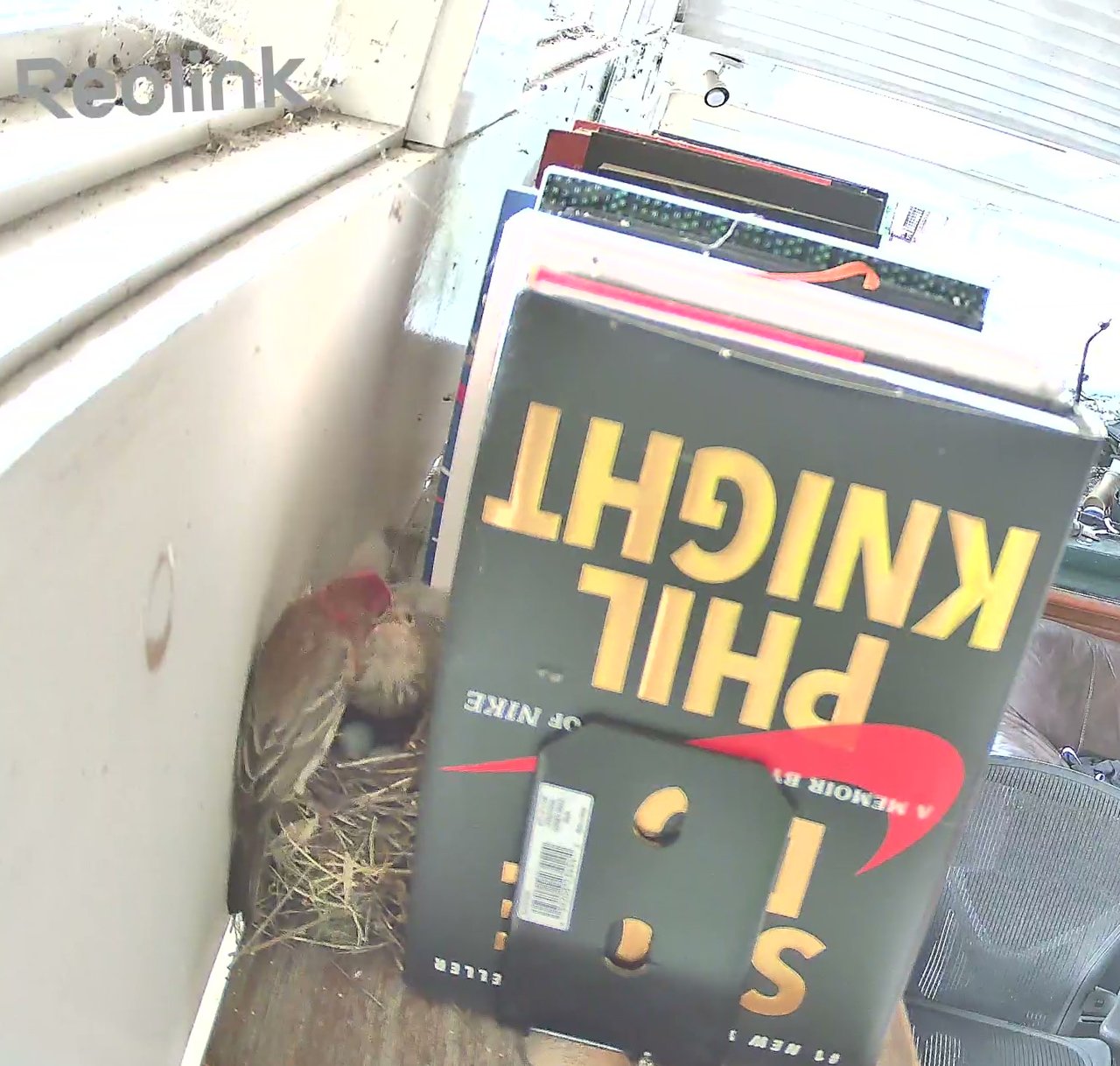
House Finch incubation is, by every field reference I trust, the exclusive work of the female. The male feeds her; he does not brood. Yet here he occupies the cup four times in a single day, his body pressed to the eggs, the female returning each time to take over what he briefly held. I note it and watch for whether Friday is anomaly or harbinger.
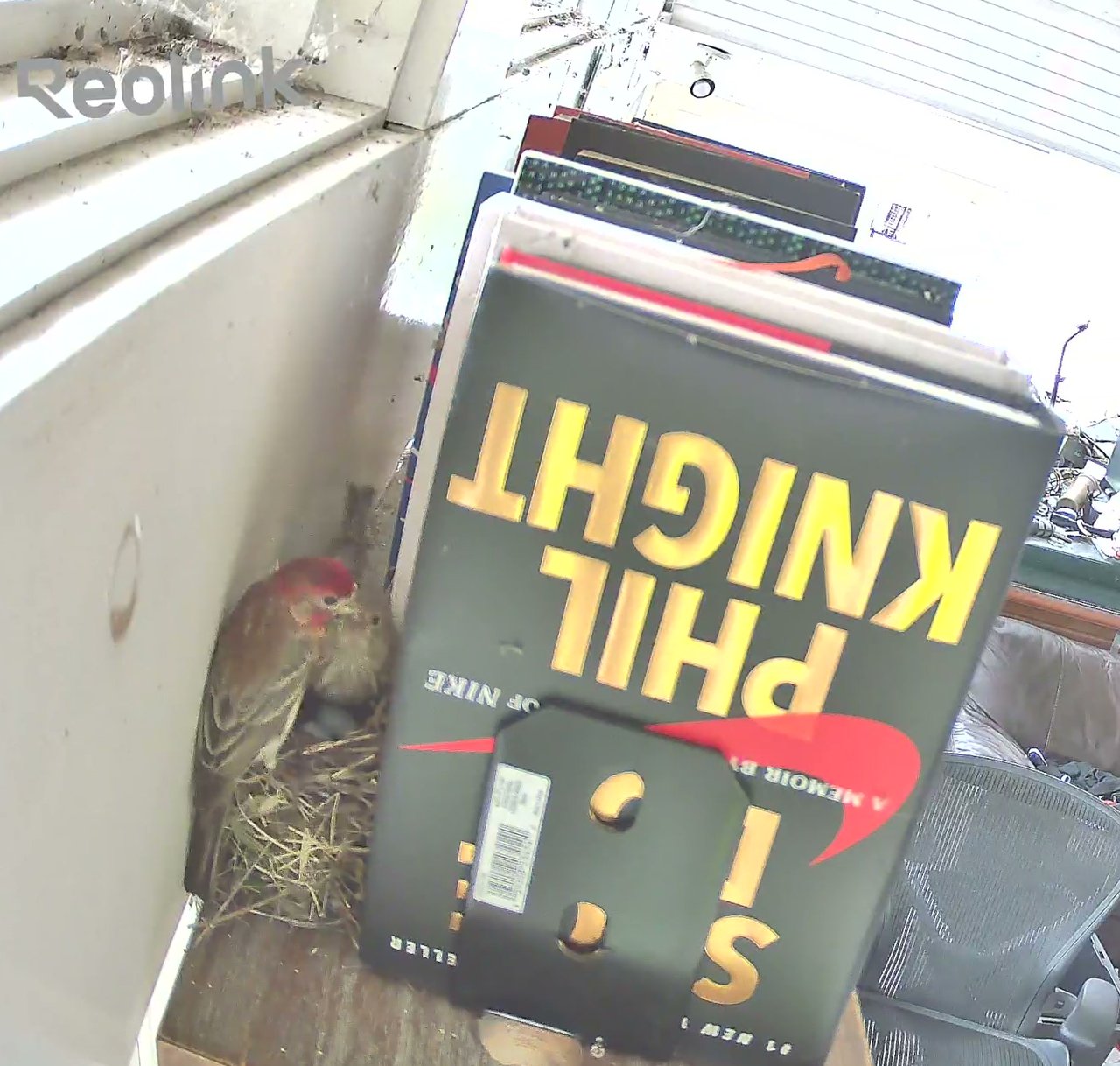
Saturday, May 2. The male reverts to orthodoxy — or something closer to it. At 13:50 he appears beside the nest on the spine of a stacked book, the female settled in the cup below his feet, and feeds her. It is the canonical courtship feeding: he stands, she receives, the eggs beneath her are not displaced. She holds the cup for the rest of the afternoon with only routine breaks.
At 17:22 a human moves through the frame — close enough that the Wyze camera registers the disturbance, one frame badly overexposed, the embedded timestamp skipping to a nonsensical date. The female is off the nest at that moment; she returns by 17:41. By 19:12 the nest is briefly empty again and the camera records all five eggs clearly, their NIR-albedo rendering them bright against the dark fiber of the cup. She is back at 19:16 and does not leave again before the cameras go full infrared and she becomes a low-contrast silhouette, continuous through midnight.
Sunday, May 3. The male is back — and he is busy. Visits at 08:37, 09:29, 10:26, 11:42, 15:37, 16:29, 17:26, 18:42, 18:59: a rhythm of contact that far exceeds the one or two courtship feedings a day recorded in most literature for this stage. What has changed from Friday is the geometry. On Friday he was in the cup, occupying the incubation posture in the female’s absence. Today he approaches while she is present, perching below or at the rim, never displacing her — yet at 14:16 he is briefly in the cup for two frames before she settles back over him.
A human crosses the sunroom at 19:54 and again at 19:55. The nest is empty at that moment; one camera records what appears to be an egg outside the cup on the shelf. A second camera, one minute later, shows all five eggs safely inside the nest. I am inclined to trust the second reading — parallax or motion blur has fooled this system before — but I flag the discrepancy. The female returns around 20:11 and does not leave again before the last IR clip at 22:15.
What the three days reveal together is not simply an active male but a male testing the edges of a role he is not supposed to have. Friday’s cup-sitting may have been displacement behavior or genuine attempted incubation; by Sunday it has softened into sustained proximity, frequent feeding, and occasional brief contact with the cup. Whether this reflects something unusual about this pair, or a more plastic behavioral range than the literature credits, I cannot say from three days of footage. But the pattern is consistent enough to follow forward. The eggs were laid; they are being incubated; the clutch holds at five. The male seems unwilling to simply stand aside and wait.