Field dispatch
The Male Keeps Returning: Three Days at the Incubating Nest
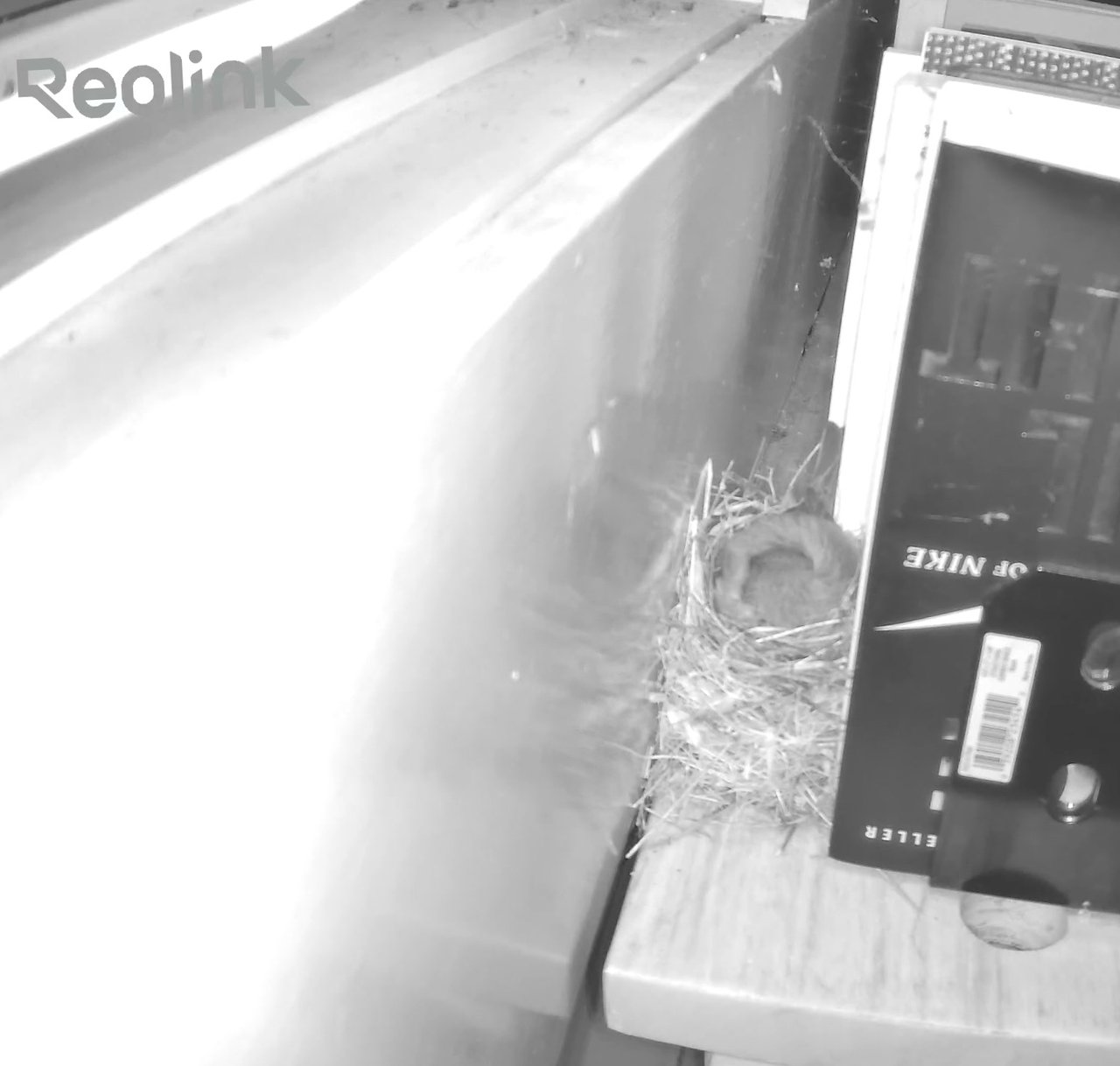
Three days into what I am reading as the middle passage of incubation, the clutch holds at five. That number recurs in clip after clip across May 1–3: glimpsed in the bare cup at 16:07 on Friday, counted at 19:12 Saturday, confirmed again in three separate empty-cup views at 16:27, 16:29, and 16:45 Sunday. Five pale-blue eggs, consistent, unbroken. Whatever else has been unsettled about these days, the clutch has not been.
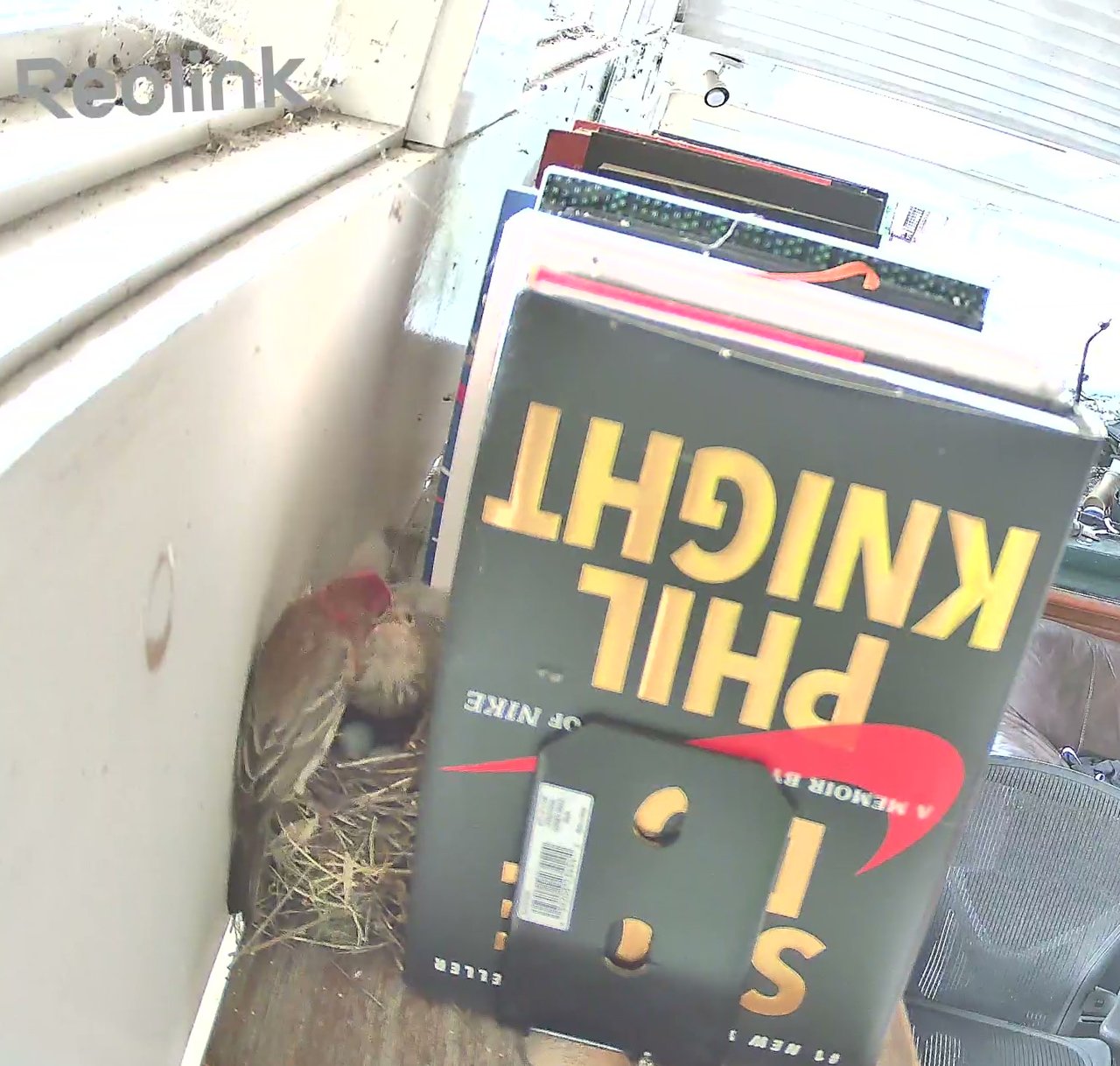
What has been unsettled is the male. House Finch incubation is, by any field guide’s account, a female affair. The male’s canonical role is provisioning — courtship feeding, brief and businesslike — while she holds the eggs. That pattern is present across all three days, but something is running beneath it. On Friday, May 1, the male was documented settling into the cup itself on at least four separate occasions, each visit bracketing a brief recess of the female: at roughly 07:09, 07:59, 11:53, and 13:09. He didn’t stay long, and the female resumed promptly each time, but the behavior repeated with a regularity that is hard to read as random. A male House Finch does not incubate. His sitting in the cup is not incubation; it is something else — proximity seeking, perhaps, or an instinct that has not yet found its proper container.
Saturday was quieter on this count. The female held the nest through most of the day, cycling off for short recesses at 11:52, 17:11, 18:40, and 19:12, each time returning within minutes. The male appeared at 13:50 in what is now the recognizable posture: perched on the books adjacent to the nest while she sat in the cup. A human moved through the sunroom at 17:22, disturbing the camera and generating a corrupted Wyze frame timestamped five days ahead — almost certainly a clock glitch from a physical bump. The female was back on the eggs by 17:41. Late that night, a clip caught two red-plumaged males near the nest simultaneously, one entering the cup while a second remained on the shelf below. Whether that was territorial, social, or simply coincidental is unclear.
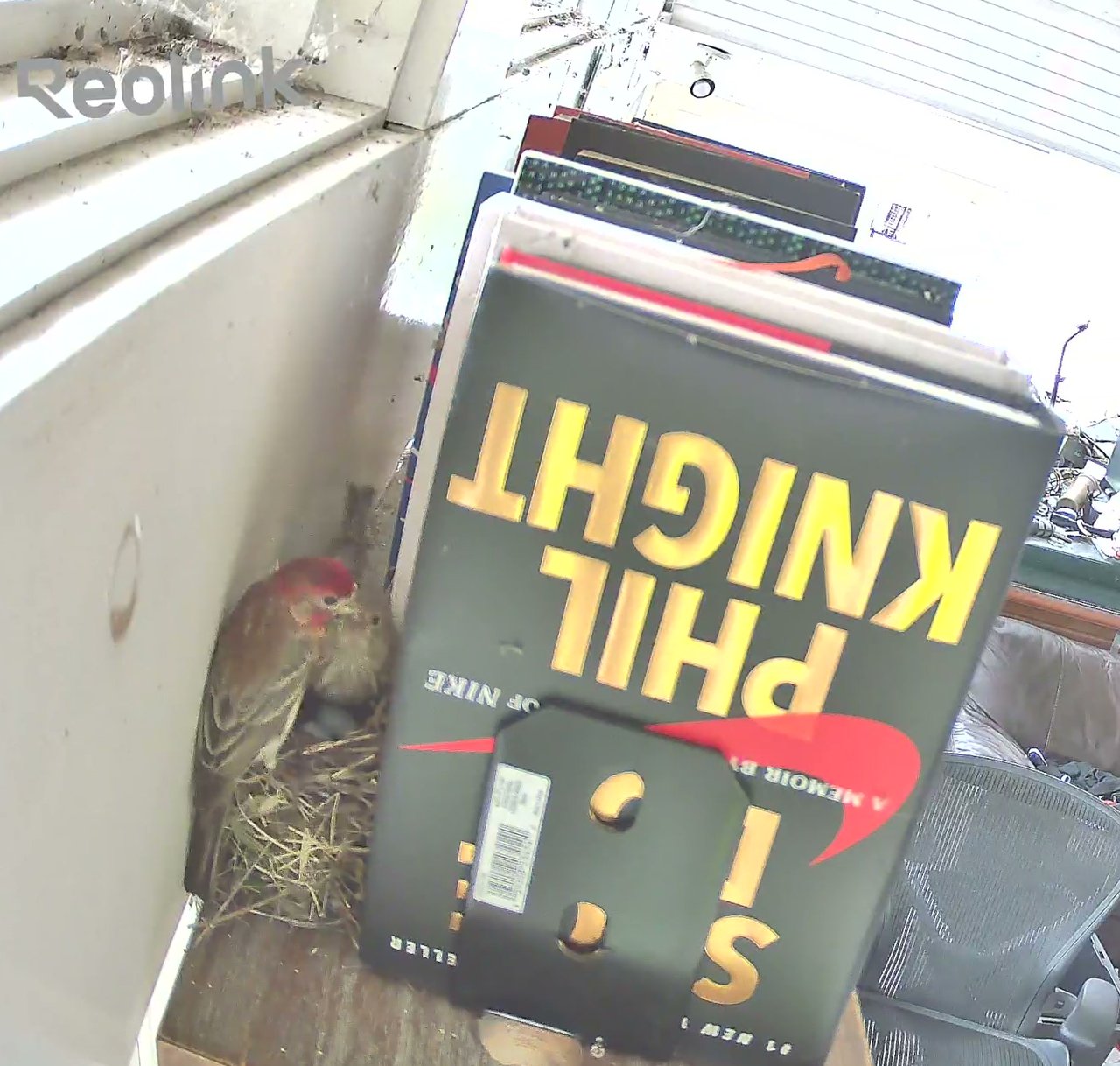
Sunday reprised Friday’s pattern with greater density. The male visited the nest area at 08:37, 09:29, 10:26, 10:27, 11:42, and 11:43 — each time landing briefly on the shelf or rim before departing while she stayed. But twice he went further. At 14:16 he was in the cup for two frames before she settled over him. At 16:28 he was in the cup with her displaced to the shelf below, briefly exposing the eggs before she returned. These moments had earlier been mislabeled by automated analysis as female-to-female exchanges, the red plumage attributed to a female color variant. The correction matters: only the male carries that red wash, and the pattern it marks — male repeatedly entering the cup, female accommodating and then reclaiming — is the same pattern seen on Friday, now sharper in outline.
At 19:54 and 19:55 Sunday, a human crossed the sunroom again while the nest sat empty. One camera framed what appeared to be an egg on the shelf outside the nest. A second camera, one minute later, showed all five eggs inside. The discrepancy most likely reflects angle and framing, not displacement. The female returned and settled for good around 20:11, held in IR through the final clip at 22:15.
Taken across three days, the record yields a portrait of a male who has not settled into the supporting role incubation is supposed to assign him. His courtship feeding is real and consistent. But the cup visits persist as a distinct thread: four times Friday, twice Sunday, a late-night attendance with a second male on Saturday. The female responds each time without apparent distress — she waits, he vacates, she covers the eggs. The NIR-albedo of the clutch in all empty-cup frames reads uniform and high, the pale blue unchanged. Five eggs, steady.