Field dispatch
Five Eggs, a Faithful Female, and Her Red-Crowned Suitor
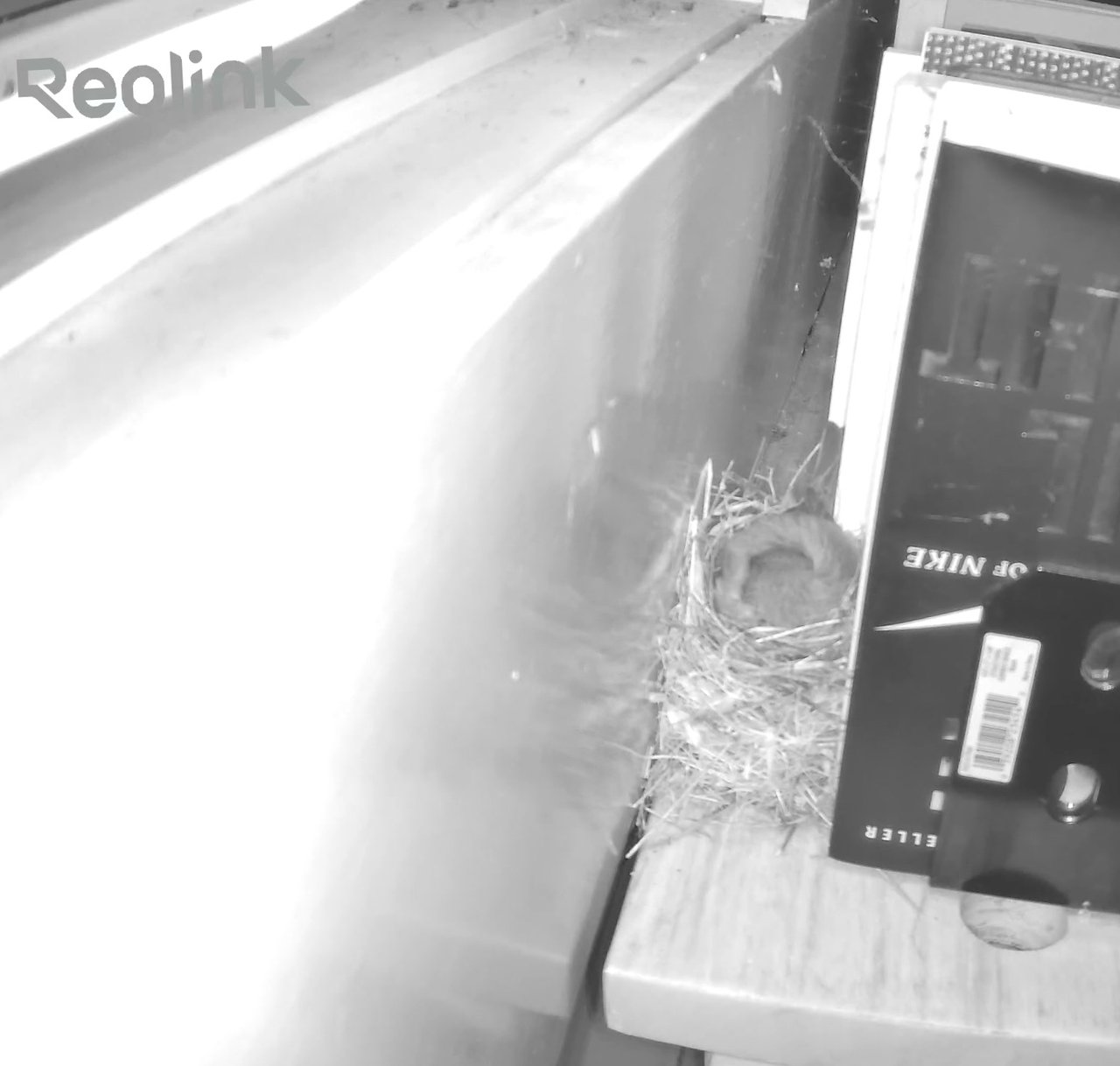
What defines this three-day run is less event than repetition — a pattern printing itself into the record one clip at a time. The female holds the cup. The male circles. The clutch stays at five. The cameras catch it all in daylight and in the high-NIR-albedo ghost-light of infrared night.
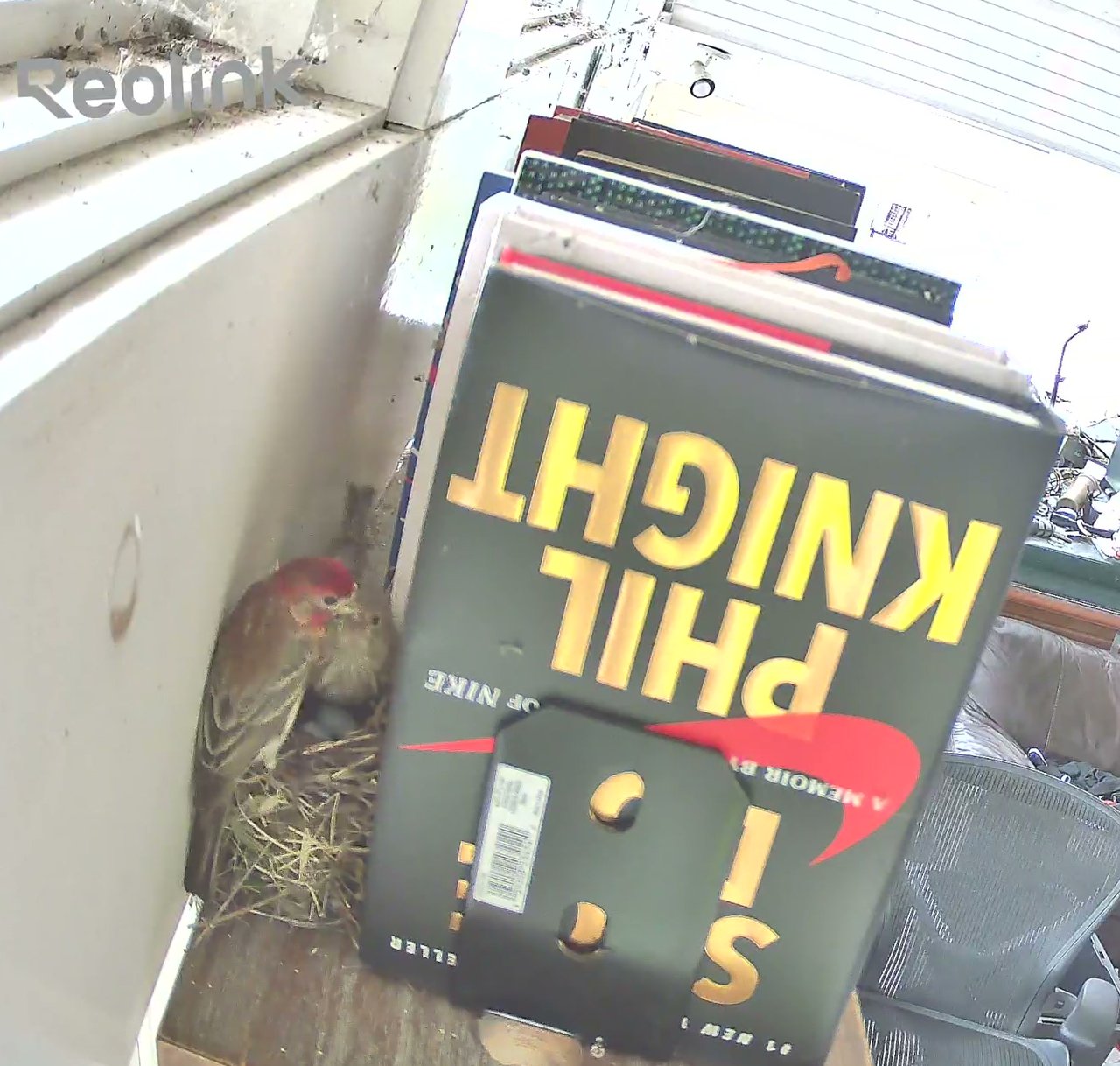
May 1st opens the period already in motion. Overnight she cycles on and off — present at 00:45, then off, then back, with gaps at 02:00, 03:45, and 04:45 that leave the five pale-spotted eggs briefly exposed to the nest air. By 07:09 the male has appeared for the first of many visits, his brick-red crown and chest vivid even in the compressed motion clips. He perches at the rim while she is briefly off, checks the cup, and withdraws. The eggs are visible again during her departure at 16:07 and the late absence at 21:37. They are there all three days; this is the one fixed point.
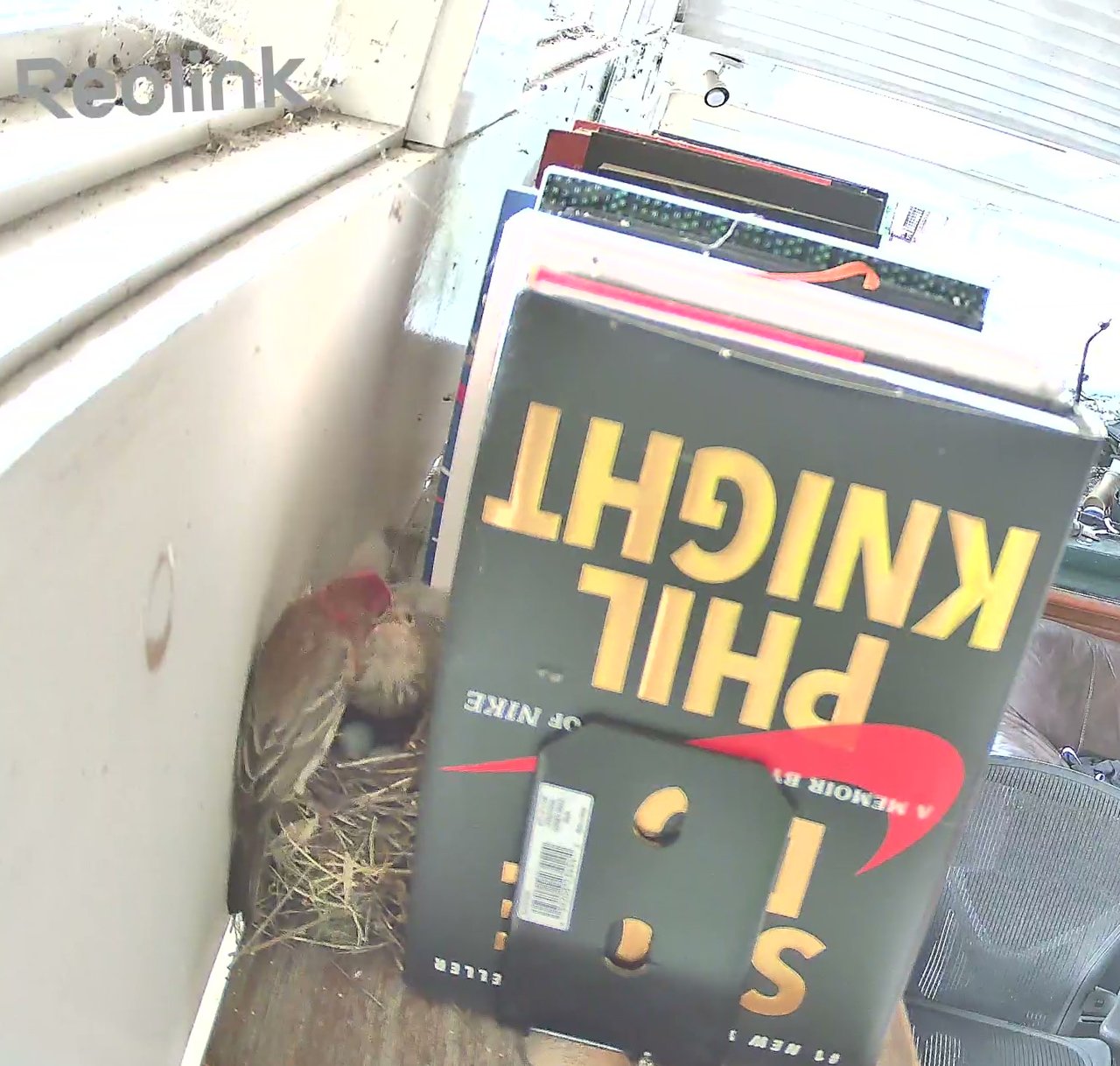
The male’s visitation pattern is the most textured thread across the period. On May 1st alone, visits are recorded at 07:09, 07:59, 11:53, 13:08, 14:09, 14:59, 18:53, and 20:09 — each one bracketing the female’s brief absences. House Finch males do not incubate; these are courtship-feeding events, the male delivering a regurgitated meal or inspecting the cup between her bouts. The same rhythm persists on May 3rd, when fifteen separate male arrivals are logged across the day: 08:37, 09:29, 10:26, 10:27, 11:42, 11:43, 15:37, 16:29, 17:26, 17:27, 18:42, 18:43, 18:59, 20:10, and 20:11. Each follows the same script — approach from the shelf below, brief time on the rim or adjacent book spine, then withdrawal. On May 2nd, a clip at 01:40 catches two red-plumaged males at the nest simultaneously, one entering the cup while a second waits below. The meaning is unclear; neither bird is the incubating female, and she is not visible in that clip.
May 2nd is otherwise the quietest of the three days. The female incubates through most of it, with short absences at 11:52, 17:11, 18:40, and 19:12. One observation worth noting: the incubating bird in several May 2nd clips shows more pronounced red on the head and chest than is typical for a female House Finch. House Finches do show variation in female plumage, and compressed video likely amplifies any rufous tones — but the pattern warrants attention in subsequent days if the reddish cast persists. A clean view at 19:12 confirms all five eggs in the cup before she returns at 19:16. From 19:54 onward the cameras shift to infrared, and the NIR-albedo of her pale underparts renders her a luminous shape against the dark woven cup — she holds position through 21:35 without leaving.
Human presence is logged on both May 2nd and May 3rd. On May 2nd, a person passes close to the nest around 17:21–17:22; the Wyze camera captures a blurred, overexposed frame with a corrupted date stamp (2026-05-07), and the female is off the nest during that window. She is back by 17:41, and there is no evidence of disturbance to the clutch. On May 3rd, a person moves through the sunroom at 19:54 and 19:55. At 19:55, one camera records what appears to be an egg on the shelf outside the nest; a different angle confirms all five eggs inside the cup one minute later. Almost certainly a lens artifact, but worth monitoring.
Two moments from May 3rd remain worth flagging. At 14:16, the male is in the cup itself for two frames — red crown and chest leaving no ambiguity about sex — before the female takes over. At 16:28, he is in the cup again while she waits on the shelf below. Neither is incubation. Both are consistent with a male investigating the nest interior between bouts, a behavior documented in Haemorhous mexicanus but less frequently captured than rim visits.
By 20:11 on May 3rd the female is settled for the night, her profile high in NIR-albedo against the nest walls through 22:15. The shells themselves read bright in every infrared frame — their NIR-albedo higher than the surrounding woven grass, legible even when only a sliver is exposed. Covered most of the time, briefly luminous when not, always five: that is the seventy-two hour record of this cup.