Three Days, the Male Drawing Closer
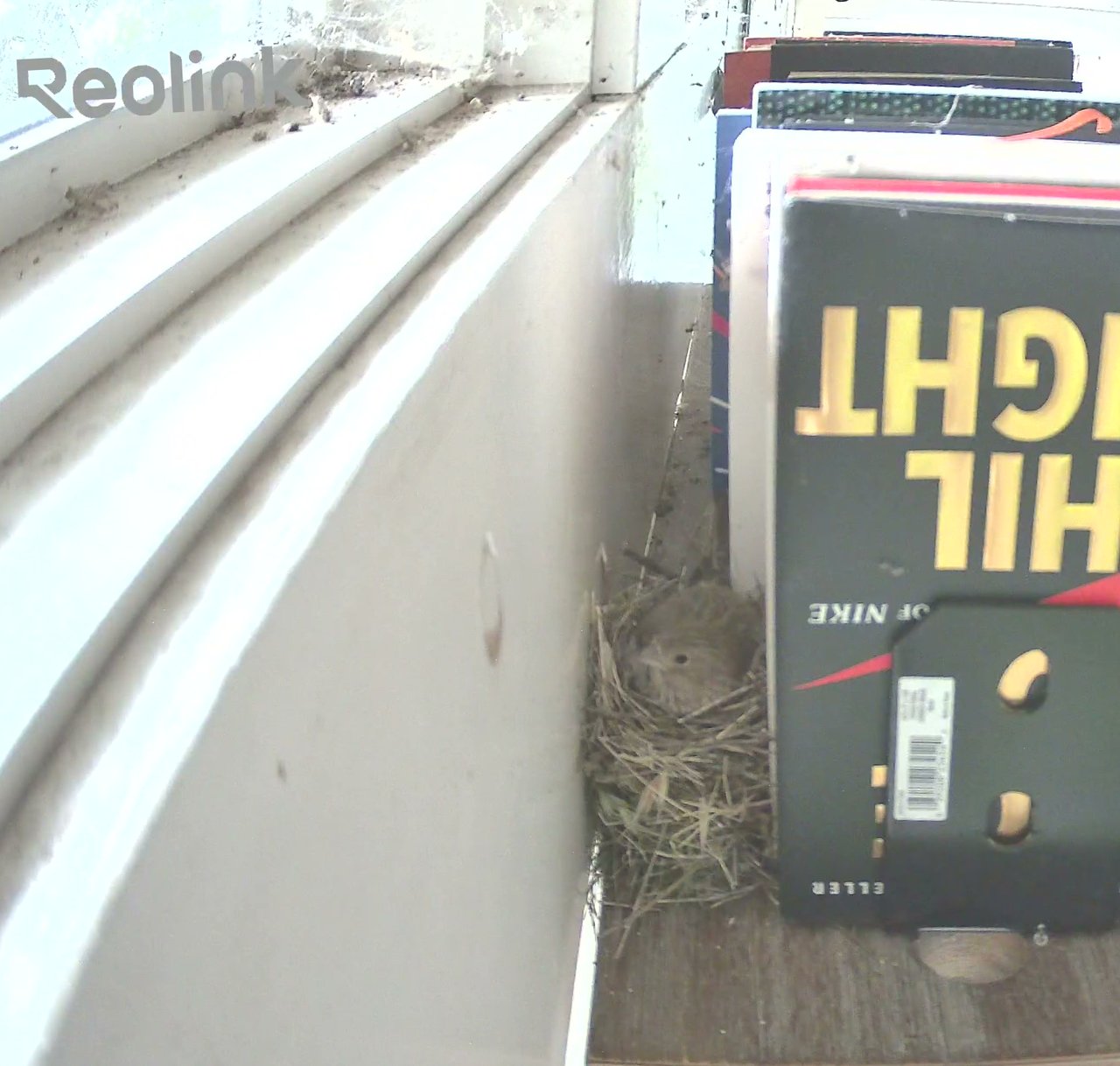
The old bookshelf camera caught its last useful frames on the evening of April 28. Both it and the Reolink picked up the same motion event at 19:55 from different angles — a clean handoff, end of one record and start of another. Across these three days the pair kept incubating, but the male’s role kept evolving.
April 28. She was on the cup at 06:00, off at 06:39, back on shortly after — the morning shift held the usual rhythm of short breaks. Two activity clusters punched through. The first ran 15:24–15:30: six motion events in six minutes, all of them me at the camera repositioning the lens. The cup sat empty for those minutes, all five eggs visible. The second cluster came at dusk, seven events from 18:25 to 18:32 — the male shuttling in for a final feeding before she locked down for the night. By 20:00 the Reolink had her on the cup in IR, low and committed. The five eggs in the late-evening empty-cup frames came up uniformly bright — each one a small clean oval against the dark grass.
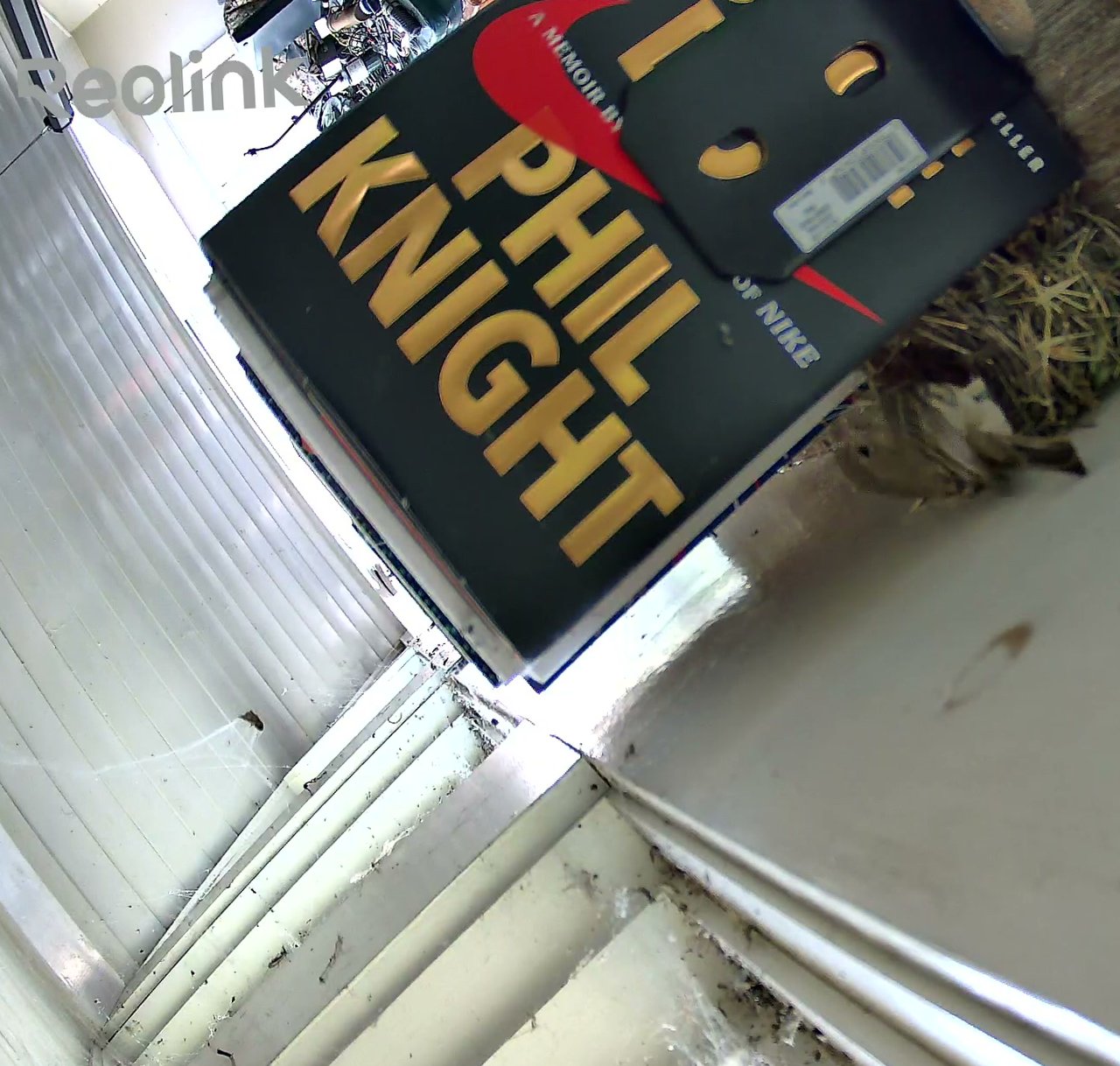
April 29. She was already on the cup at 06:11. During her short breaks through the morning the male visited the cup itself at 10:35, 11:33, and 12:43 — stepping briefly into the bowl each time. House Finch males don’t incubate, so this isn’t relief. It’s a nest check, or a feeding handoff while she’s just off, or both. Each time she returned within a minute and resumed without fuss. By evening the regular shape was back: male at the rim at 18:33, both birds close at 19:44 and 19:45, female settled by 20:02.
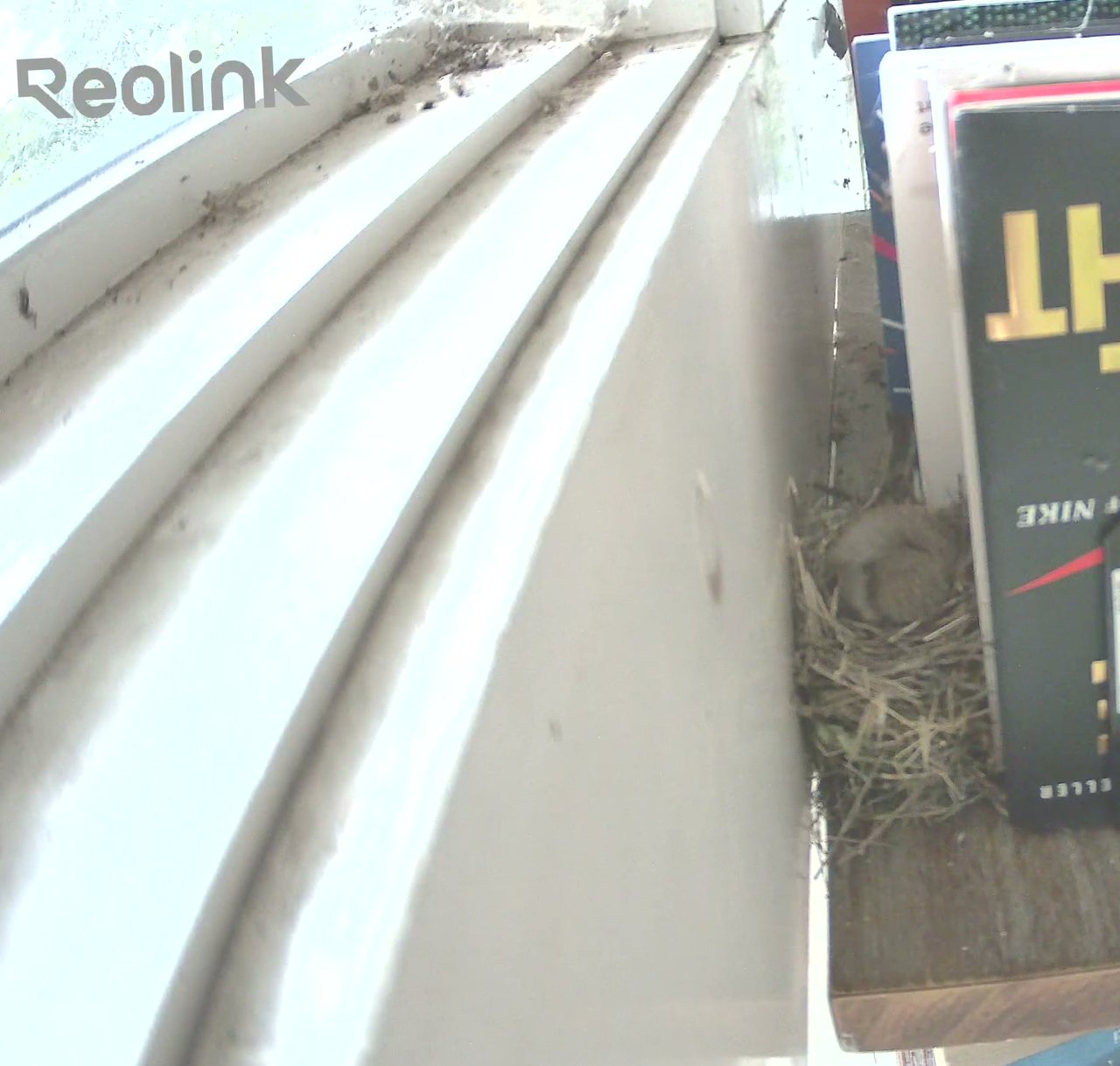
The 29th’s wider angle showed only two eggs — the cup geometry was hiding the others behind the rim. Five had been confirmed the day before and would be again the next afternoon. The eggs aren’t going anywhere; the camera just can’t always see them.
April 30. Cleaner rhythm. Male at 08:09, female steady through the morning. At 15:09 the male arrived at the rim, gone within seconds; at 15:10 she dropped into the cup as he left — the kind of handoff that looks rehearsed. At 17:09, with the male perched beside an empty cup, all five eggs were visible again, the same five we’ve been counting since the 26th, in the same arrangement. Evening followed the now-familiar arc: male at the rim at 18:21, on the shelf below at 19:18, female through the night.
What’s changed across the three days is the male. He was at a distance on the 28th — books, shelf, a flyby at dusk. By the 29th he was in the cup itself during her breaks. By the 30th he was orbiting closer all day and arriving in time to clear the rim as she came back. Her shifts have lengthened in the same window. She’s on the eggs more; he’s circling tighter. The five eggs are the gravitational center.