Field dispatch
Five Eggs, One Pair, Three Days of Courtship Feeding
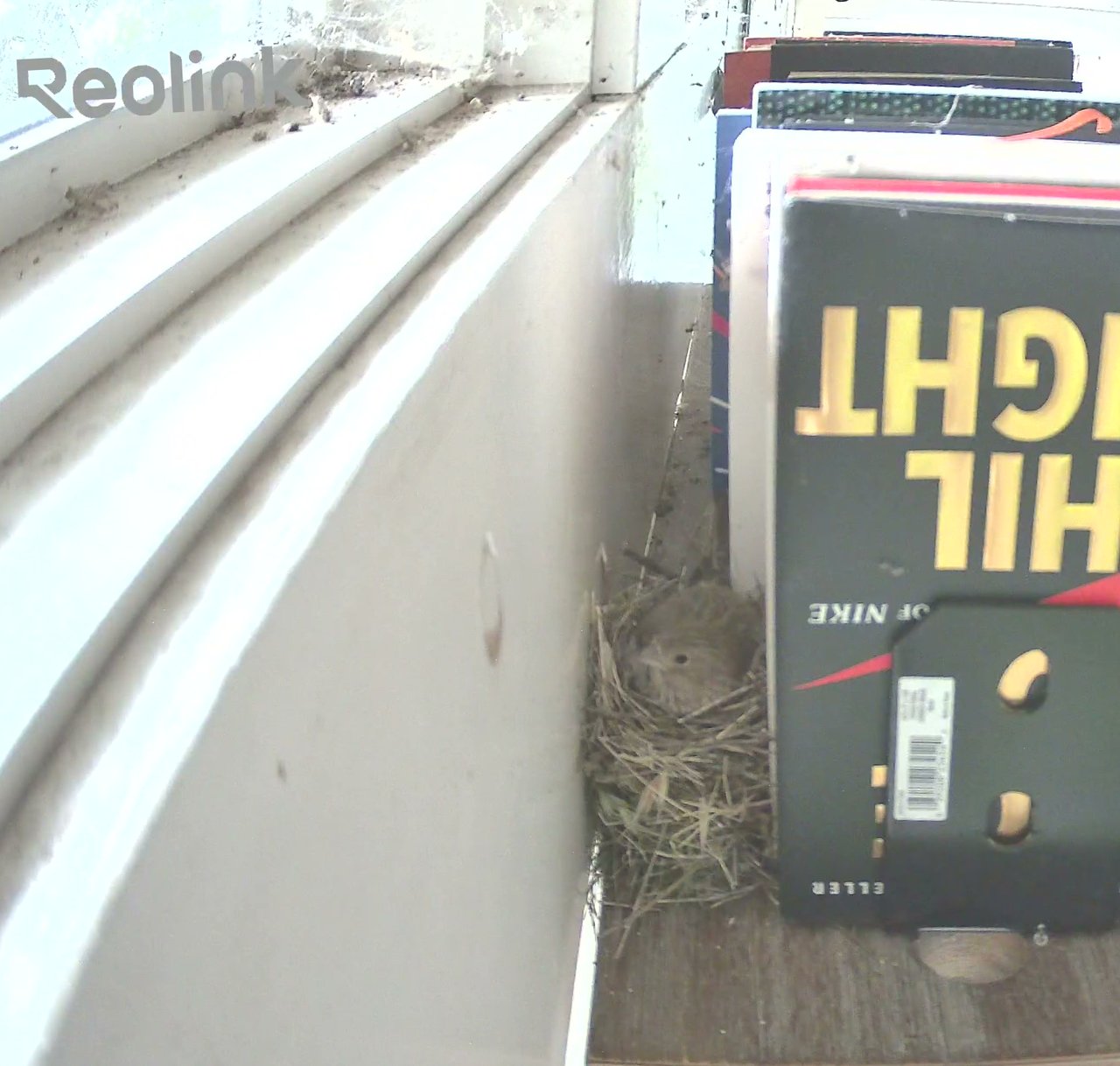
These three days — Tuesday through Thursday, April 28–30 — resolve into a single coherent picture only when read as a unit. Taken day by day, what the cameras show is ordinary: a female House Finch on the cup, a male nearby, brief recesses, and then the female back. Read across the span, a rhythm emerges that is worth documenting carefully.
The clutch. The firmest number in the record appears at 21:00 on April 28, when the female steps off and the old bookshelf camera frames the nest cup cleanly: five eggs, pale and finely speckled, their high NIR-albedo giving each shell a faint luminescence in the IR frame. After the camera handoff that same evening — the Reolink sunroom unit becoming the primary sensor from roughly 19:55 onward — the geometry changes. The new angle presents the cup from a lower, more oblique position, and the result is that on April 29 and 30, clips showing an empty cup reveal only two eggs from that vantage point. The clutch did not shrink. The camera moved.
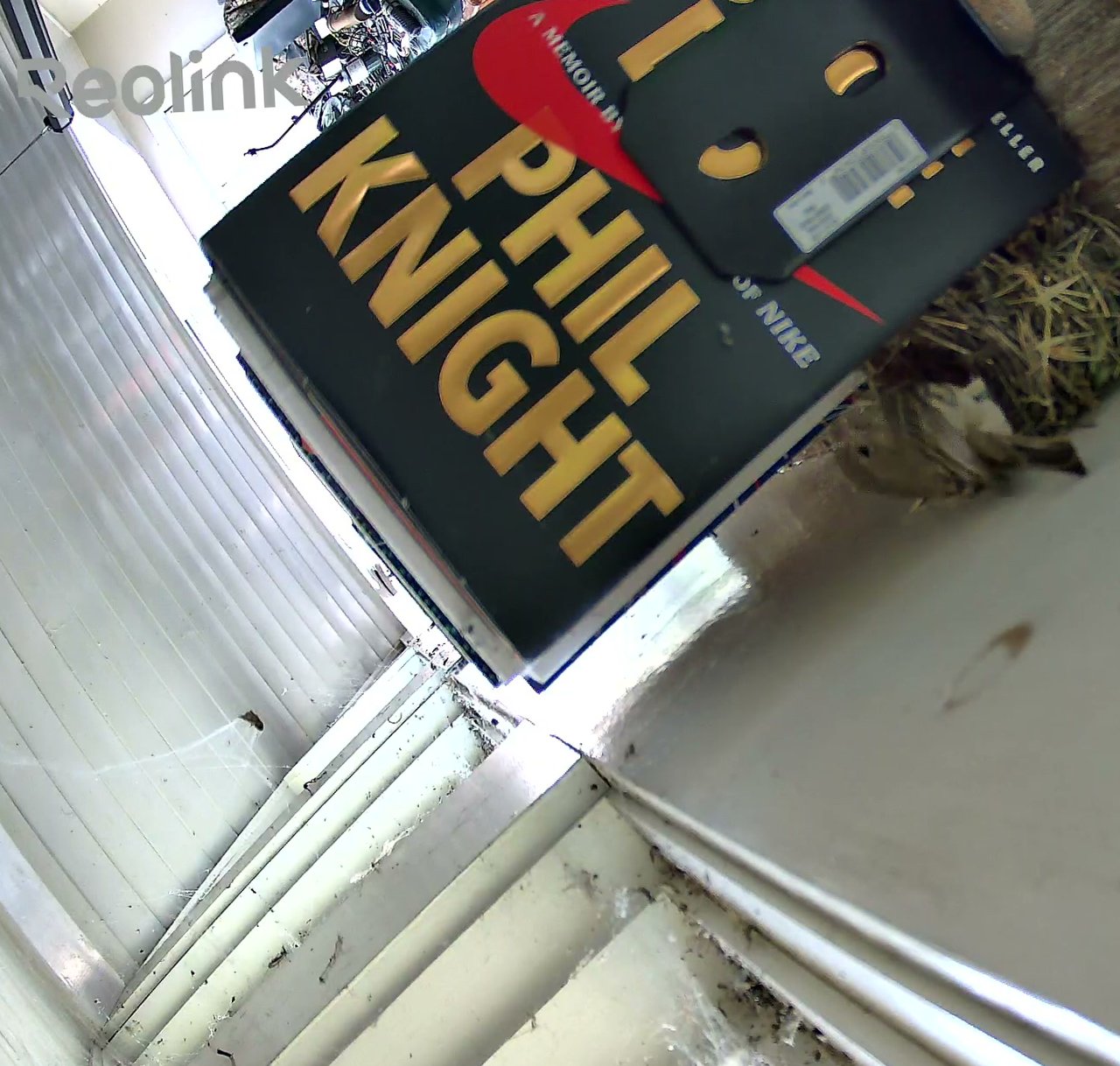
The camera handoff. April 28 was the day the old bookshelf cam completed its run. The overlap window at 19:55–19:56 is one of the more useful moments in the three-day record: both sensors captured the same motion event from different angles, confirming the female was settling for the night. By 20:01, the Reolink shows her in a low incubation posture in the IR frame, and that is where she stays. The handoff was clean. The gap is interpretive, not observational — what we lose is not data but a familiar perspective.
The male’s role. The pattern that ties all three days together most clearly is the male’s attendance. On April 28, he appears on the bookshelf or nest rim at 14:00, 14:01, 19:44, 19:55, and 21:01 — courtship feeding passes, each brief. The two afternoon activity clusters that day — six events between 15:24 and 15:30, then seven between 18:25 and 18:32 — likely include several of these approaches, though the bookshelf cam descriptions from those windows are less specific. On April 29, the male is documented at the nest at least six times between 16:35 and 19:46, approaching from the shelf below, touching the rim, and withdrawing. On April 30, the visits continue: 15:09, 15:53, 17:09, 18:21, and a paired cluster at 19:18. The male is not incubating — House Finches do not divide that labor — but he is consistently present, and consistently close.
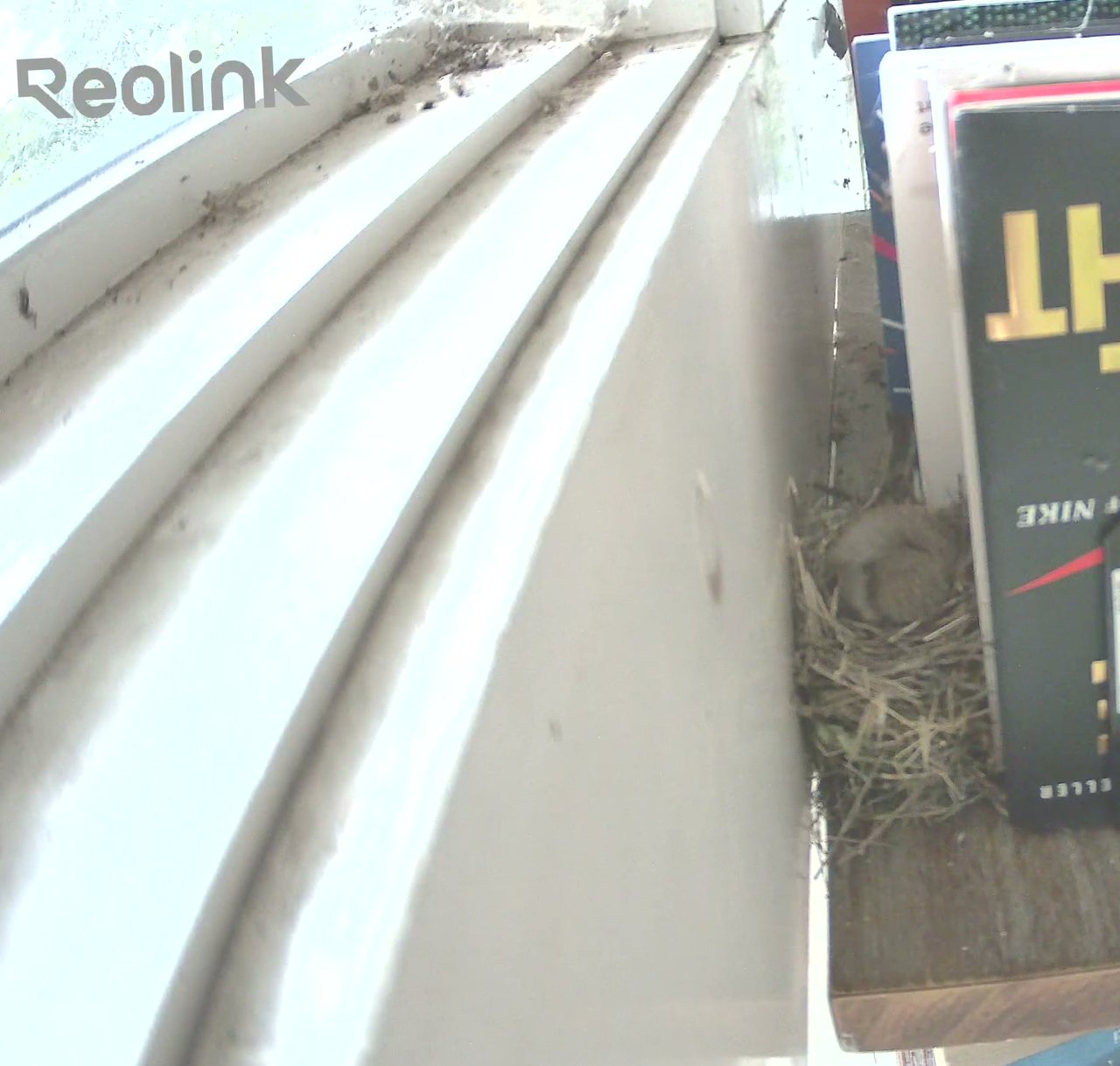
The female’s rhythm. Her incubation sessions are long and interrupted by short recesses. On April 29, she is on the cup from first light — 06:11 — with two brief lifts before 07:00, then continuous through 09:35. The recesses, when they come, are measured in minutes: the nest sits empty at 11:28 for a few minutes, again at 14:16 and 15:10 on April 30. During these brief exposures the eggs’ faintly speckled shells read with high NIR-albedo against the woven nest lining — a contrast that makes counting straightforward when the camera geometry cooperates. These pauses are not abandonment; they are the ordinary time-energy tradeoff of a small bird sustaining itself across a multi-week sit.
The late-night anomaly. One timestamp stands slightly apart: at 00:19 on May 1, logged under April 30, the male is observed sitting in the cup. This is an unusual position for the male at that hour. The most parsimonious reading — given what the three-day record otherwise shows — is that the female had briefly stepped off and the male moved to the cup, a nest-check visit extended by her absence. House Finch males do not incubate. The female was back on the cup by dawn on May 1.
What the three days establish. The clutch is five. Incubation is active and primary by the female. The male visits on a reliable schedule — multiple times each afternoon and into the evening — fully consistent with sustained courtship feeding. The camera transition introduced a perspective shift that limits egg-counting from the new angle but does not compromise behavioral observation. There is nothing in the April 28–30 record to suggest anything other than a normally progressing clutch.