Field dispatch
Three Days Into the Long Sit: Finches at the Bookshelf
What strikes me most, reviewing three days of footage, is how quickly incubation rhythm emerges from what first looks like noise. On the 25th, the visits feel scattered—bursts of phone photos at 16:06 local time, a pause, the nest empty again at 17:24—and then, somewhere in the evening, a shift: the female sinks low into the cup and does not come back out. By the 27th, the pattern has tightened into something almost metronomic. That arc—from possibility to commitment—is what these three days document.
April 25
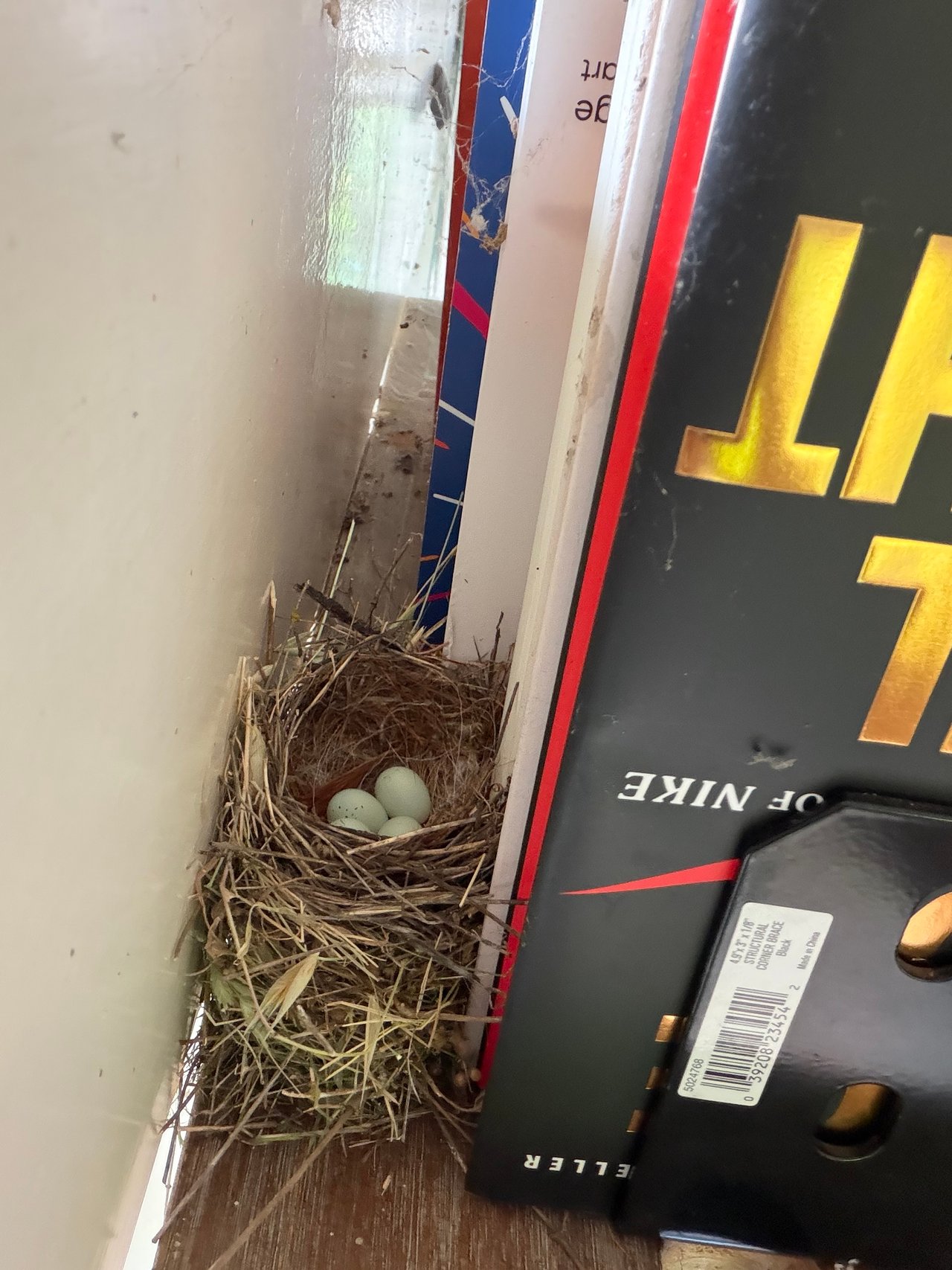
The first clear look at the eggs comes from hand-held iPhone shots around 16:06, taken during what was plainly a foraging break. The cup sat unattended, and from several angles the pale-blue speckled eggs were visible against the dried-grass lining. Because the depth of the cup and the angle of each frame varied, the apparent count shifts from shot to shot—this is geometry, not biology. What is unambiguous is the color and spotting: distinctly Haemorhous mexicanus, House Finch.
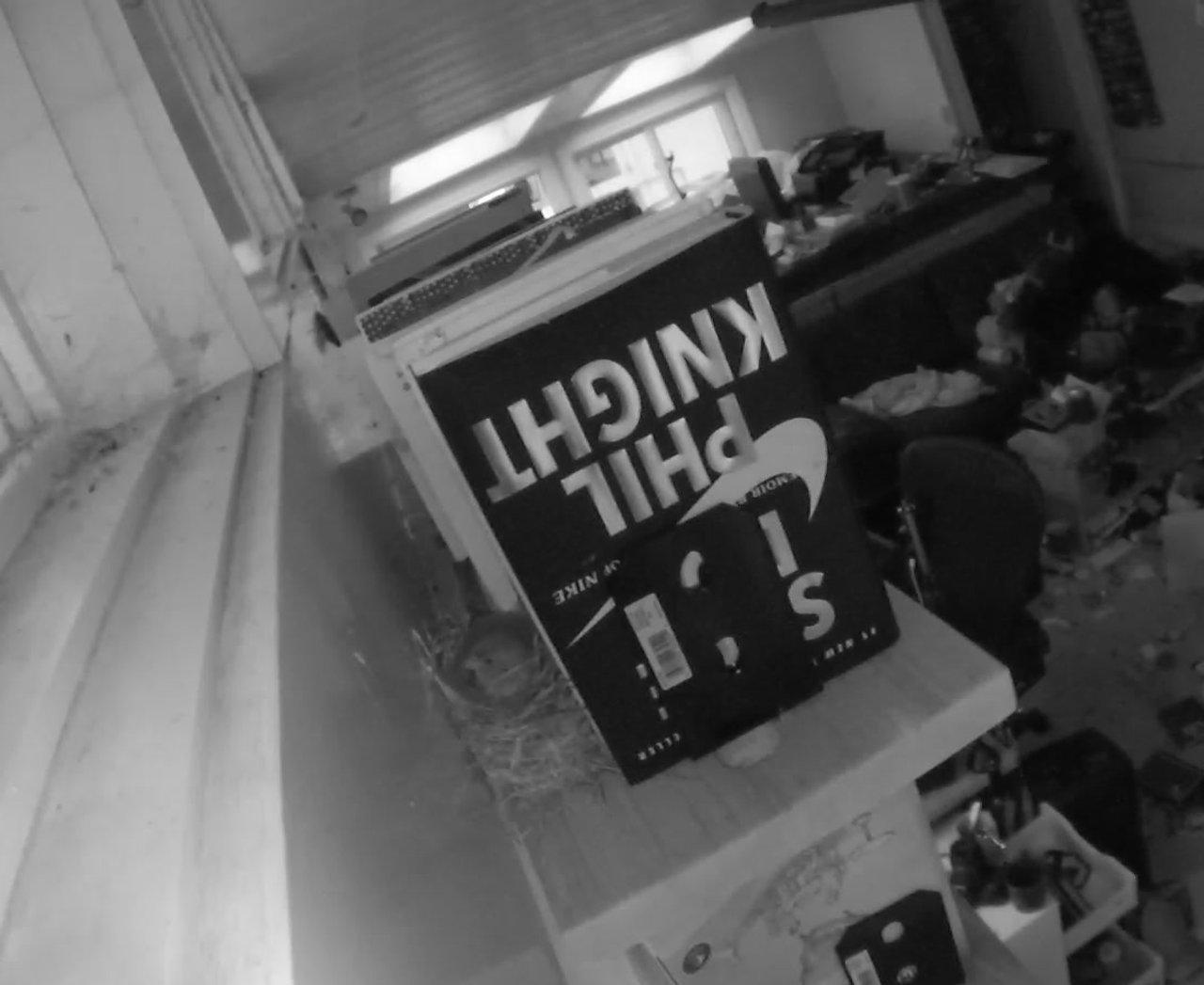
By 21:13 she was back, settled and still in IR mode, her body filling the cup. The bookshelf camera caught her again at 22:16—head tucked, the NIR-albedo of the eggs invisible beneath her—and she did not move again that night.
April 26
Sunday opens with the dawn shift already underway—at 06:22 and 06:23, two events forty-eight seconds apart, the classic relieving-off-and-on signature of early incubation. By this point five eggs are confirmed in the cup, their pale shells rendering as high NIR-albedo ovals in the IR frames whenever the female stands or departs briefly.
The male appears repeatedly through the day—at 06:41, around 13:07, at 18:19, at 20:07—perching on the spines of the books above or beside the nest, dipping briefly toward the female, then departing. This is courtship feeding carried into the incubation phase: provisioning the brooding bird so she can maintain her sit. His visits are not random. They cluster around the times when the female has been on the eggs longest, as if responding to her stillness.
The most arresting moment of the day is not avian. Around 13:20–13:30, Casey and a child move through the sunroom, working close to the bookshelf. The female stays. At 13:25 she is still on the eggs while a person leans in; only when proximity becomes maximal does she flush. Her tolerance is a data point in itself—these birds have calibrated their flush distance to human activity in this room and found it manageable.
April 27
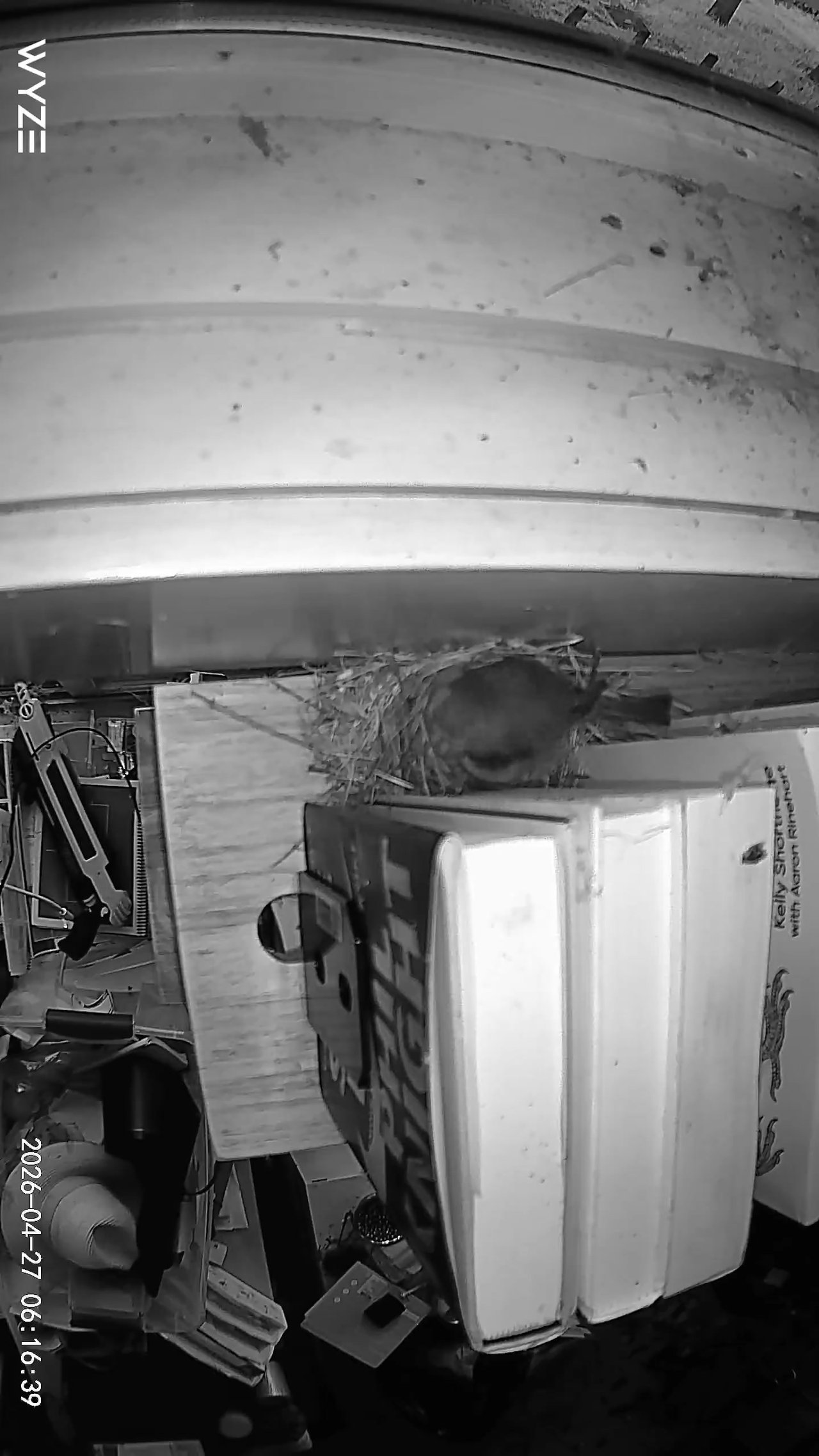
Monday belongs to the morning. From 08:34 through 09:20, seven motion events in twenty-four minutes—the densest cluster in the three-day archive. The Wyze camera, tighter-cropped than the bookshelf unit, shows the female sitting deep in the cup at dawn (06:16, confirmed by OSD timestamp), never fully off the eggs through the night, then suddenly in motion as the morning feeding window opens. The male is at the bookshelf at 10:17, red plumage unmistakable in color frames, pausing beside the nest before departing without entering.
By afternoon the rhythm has settled into what I am starting to think of as the triple: three events in a two-minute window, repeated roughly every hour. At 10:15, 10:17, 10:17. At 11:12, 11:13, 11:13. At 14:11, 14:12, 14:13. At 15:45, 15:45, 15:46. The female arrives, sits, stands and departs briefly, the male transits, she returns. It is not three distinct visits—it is one behavioral unit expressed as three triggers to the motion sensor.
Two late-night events at 21:21 and 21:22 break the silence. Nothing in the resolution resolves what caused them—a light from another room, a settling adjustment, a moth drawn to IR. They are worth flagging precisely because they don’t fit the pattern.
The emerging shape
Across these three days a House Finch pair has moved from early-incubation variability into something that looks like commitment. The eggs—five pale-blue ovals, speckled, sitting in a dried-grass cup on a bookshelf—have been continuously guarded through two nights. The male provisions; the female broods; the triple-event rhythm has appeared and stabilized. If the last egg was laid on or near the 25th, the hatch window opens around May 9–12. The nest is on schedule.