Field dispatch
House Finch Clutch Complete: Three Days of Incubation Takes Shape
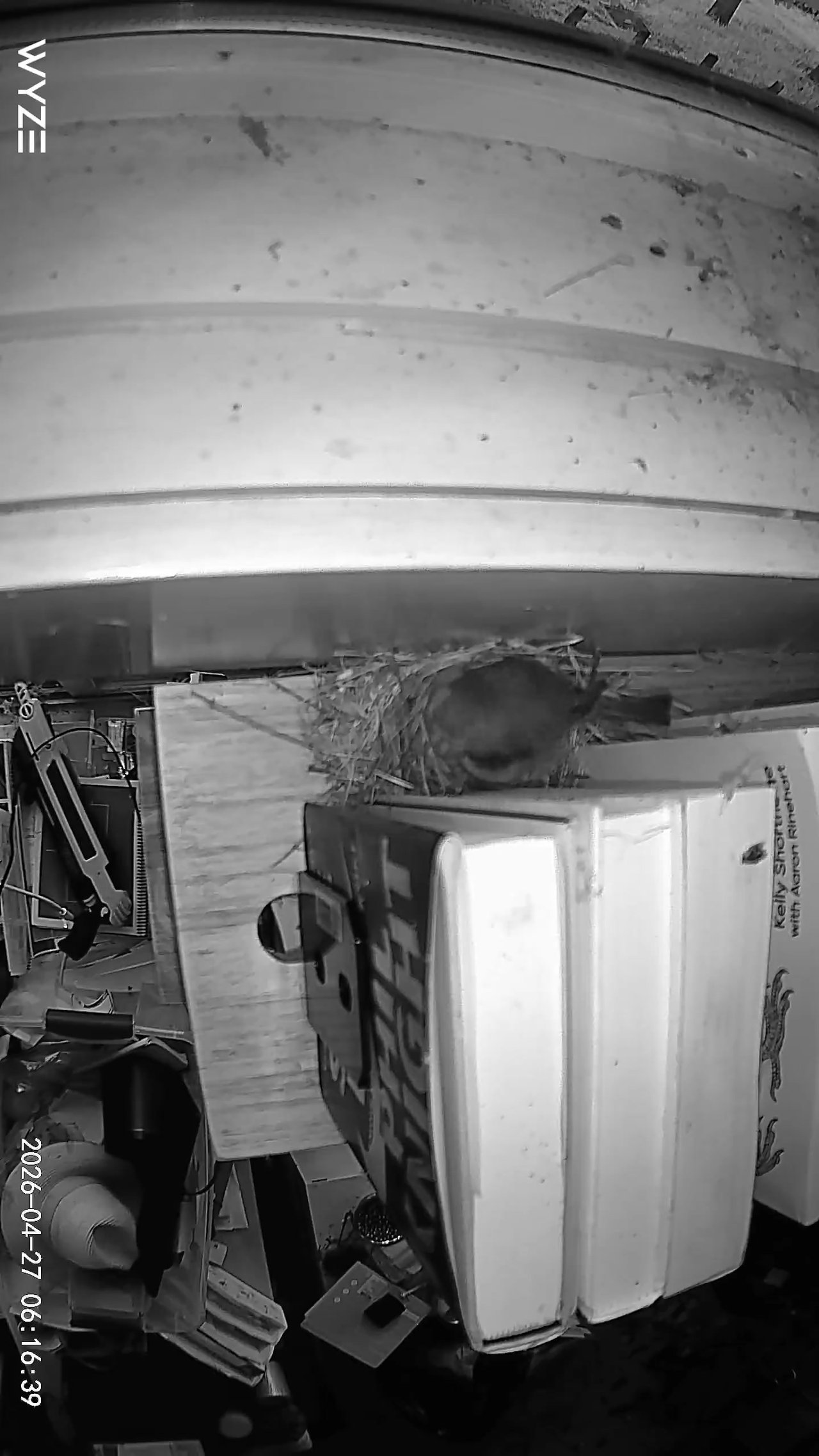
The nest occupies the third shelf from the top, wedged between the spine of a propped paperback and the wall — a compact grass cup built low and dense, the kind of structure that reads as deliberate the moment you find it. These three days mark the shift from active laying to established incubation, and the cameras caught enough of it to read the emerging rhythm clearly.
April 25. A foraging break in the mid-afternoon opened a window to the cup, and the eggs were plainly there — pale blue, finely speckled dark, arrayed in the dry grass base. How many exactly was a matter of angle: the curved cup wall occluded varying numbers of shells at different sight lines, and frame-to-frame counts shifted without any real change in the clutch itself. What did not shift was the NIR-albedo of the shells, high and consistent relative to the surrounding dried grass, making each egg read clearly against the darker matrix regardless of viewing geometry. By 21:13, the infrared exposure showed the female settled low in the cup, head tucked, body filling the cavity with no gap between bird and nest wall. Overnight incubation had begun.
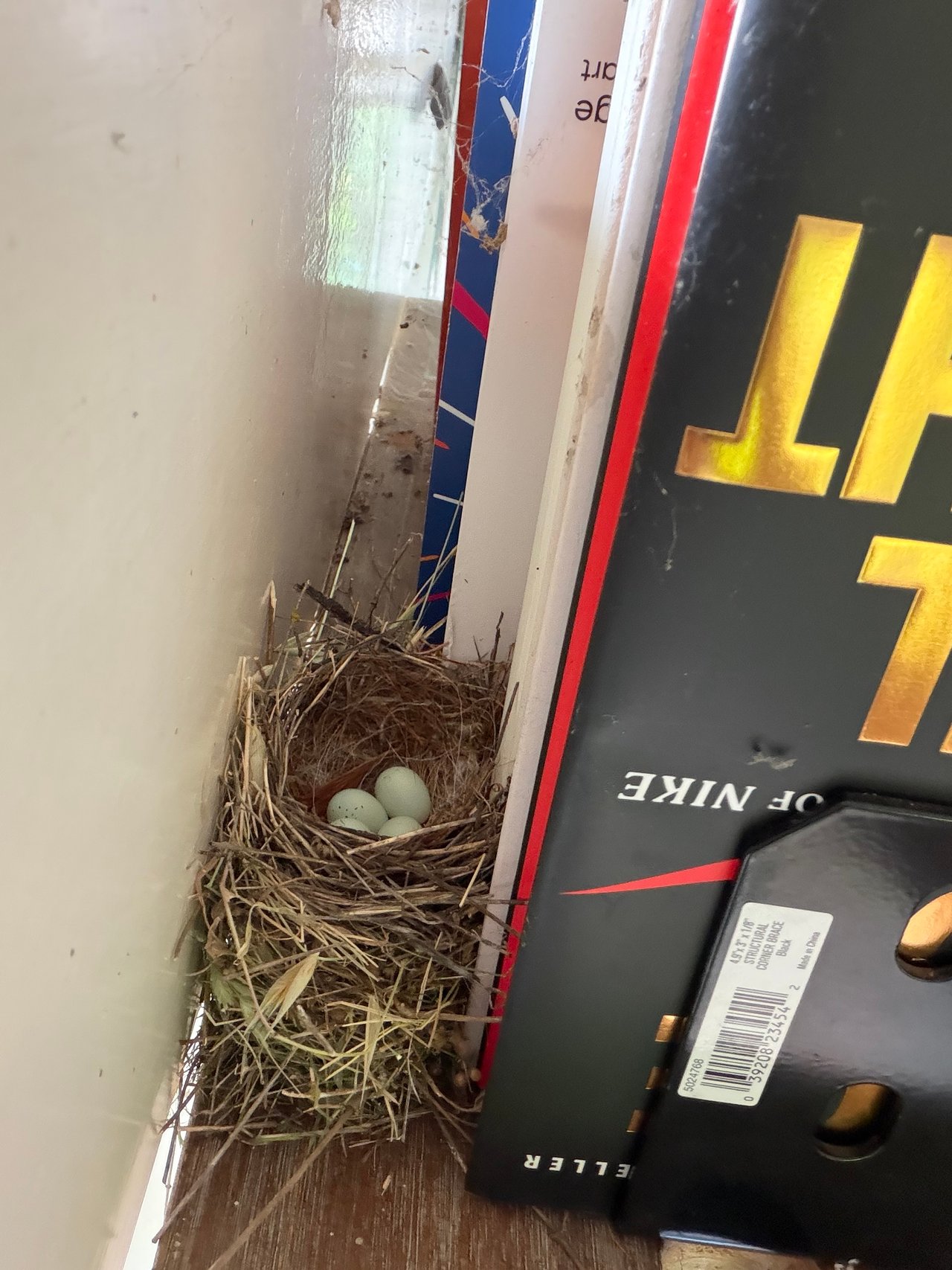
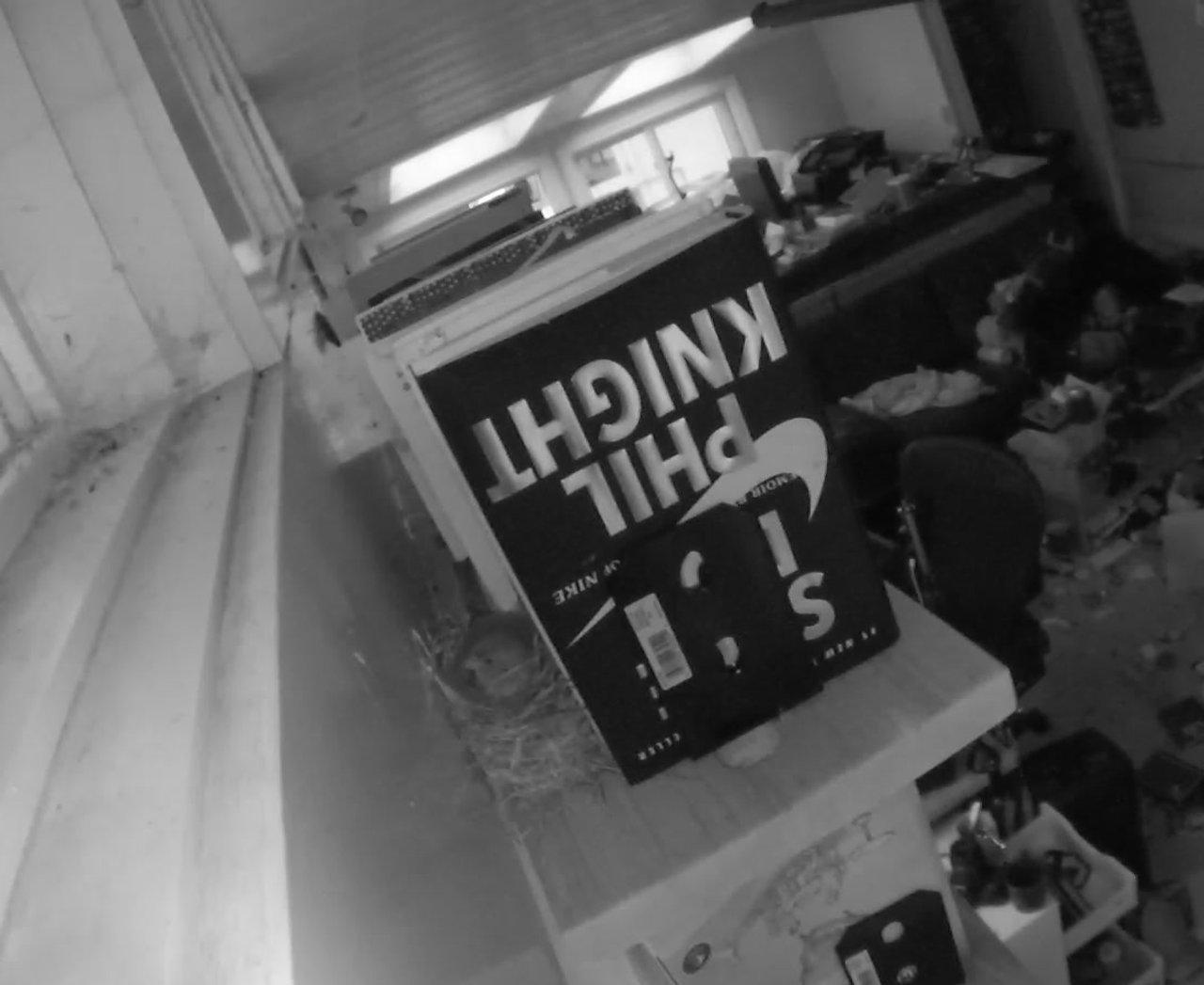
April 26. The male appeared early — perched above the cup on the row of books at 06:41, then gone without entering. He cycled back through the morning and afternoon in the pattern that would come to define both remaining days: arrive, make near-contact with the incubating female, depart. By midday, five eggs were confirmed from above, their pale shells reading cleanly against the nest grass. The female’s bouts that day were shorter and less steady than they would become — she’d settle, then shift, then leave, then return, never locking in for more than a brief stretch at a time. A human approach between 13:20 and 13:30 — a taller figure and a child moving actively through the adjacent room, a device brought close to the cup — caused a single flush. She was back within minutes, and the five eggs held undisturbed through the rest of the afternoon.
April 27. The Wyze camera — a tighter crop than the bookshelf unit, the nest filling a meaningful fraction of the frame — confirms the female on the eggs continuously from at least 06:16, breaking only for the briefest handoffs through the early morning. The densest cluster of the three-day record came between 08:34 and 09:16: seven trigger events across forty minutes, both cameras firing nearly simultaneously on several passes. This was peak feeding activity — the male arriving and cycling away in tight loops while the female barely shifted position in the cup.
The triple-visit signature — three events separated by seconds to a minute, then silence for an hour — repeated at 10:15–10:17, 11:12–11:13, and 14:11–14:13. Each cluster almost certainly represents a single feeding visit broken into arrival, food transfer, and departure, the male running the loop and the female accepting without abandoning her post. Late in the evening, at 21:21 and 21:22, two events fired in quick succession: a settling adjustment, or a brief ambient disturbance. The female was back on the eggs by the second frame.
Taken across the three days, what emerges is a behavioral gradient rather than a single moment. The first evening was tentative — one bird, one night, the female still settling into the task. The second day introduced the social dimension: the male’s courtship feeding visits beginning, the human presence testing the pair’s threshold, the shorter and interrupted bouts of a bird still calibrating. By the third day, both were operating on a recognizable schedule, the triple-visit pattern repeating cleanly every hour. The five eggs, confirmed from April 26 onward, sat between visits in the cup undisturbed — high-NIR-albedo shells against dry grass, patient and still, working out the arithmetic of incubation on their own terms.
If the clutch closed on April 25 or 26, the hatch window opens somewhere around May 9–12.